


Airlines face mounting financial pressure as nearly a quarter of their outstanding debt falls due within the next 12 months, increasing the risk of higher borrowing costs amid elevated fuel prices and rising interest rates, according to the International Air Transport Association (IATA).
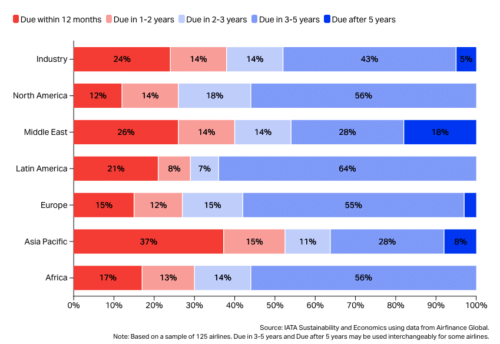
In its latest economic analysis, published on 16 October, IATA found that 24% of airline debt matures within a year, while approximately two-thirds falls due beyond the next two years. Although the industry’s relatively long-term debt profile offers some protection against immediate refinancing pressures, carriers approaching maturity dates could face higher debt-servicing costs as they refinance existing obligations.
The analysis incorporates interest-bearing debt and aircraft finance lease liabilities, which generally extend over several years and contribute to the industry’s longer debt-maturity profile. Around 43% of airline debt is scheduled to mature within three to five years, providing some breathing room for carriers facing immediate financial pressures.




However, rising government bond yields following policy-rate increases in the United States, Europe and Japan have pushed up financing costs across different debt maturities. As existing obligations come due, airlines may have to refinance at less favourable rates, putting further pressure on profitability and cash flow.
Asia Pacific Faces the Greatest Refinancing Pressure
The exposure varies significantly across regions, with Asia Pacific airlines facing the largest proportion of debt due within the next 12 months.
According to the figures provided in the analysis, 37% of Asia Pacific carriers’ debt matures within a year, followed by the Middle East at 26%, Latin America at 21% and Africa at 17%. European airlines face a near-term maturity share of 15%, while North American carriers have the lowest exposure at 12%.
The Middle East presents a mixed picture. While airlines in the region face substantial near-term refinancing requirements, the region also has the largest share of debt maturing beyond five years, at 18%. This highlights differences in the timing of financial obligations across regional airline markets.
IATA cautions that carriers with high debt levels, shorter repayment schedules and weaker credit ratings are likely to face the greatest refinancing penalties. Their ability to absorb higher interest costs will depend on their balance sheets, cash generation and access to capital.
Higher Financing Costs Could Delay Fleet Renewal
The implications extend beyond debt servicing. Higher interest payments could leave airlines with less cash available for debt reduction, fleet modernisation and investments in decarbonisation.
These pressures come as the aviation industry continues to grapple with aircraft supply-chain constraints and an ageing global fleet. IATA reported in June that the average aircraft fleet age had reached a record 15.2 years, reflecting persistent delivery delays and shortages of replacement aircraft.
Older aircraft generally consume more fuel and can require higher maintenance expenditure, making fleet renewal an important consideration for airlines seeking to improve operating efficiency. More expensive financing, however, could make the acquisition or leasing of newer aircraft more difficult, potentially extending the service life of less-efficient fleets.
For air cargo operators, the wider financial environment is also significant. Cargo capacity, operating costs and fleet investment decisions are closely linked to the financial health of passenger and freighter operators. Sustained refinancing pressure could constrain investment decisions and limit the flexibility available to airlines as they respond to changing market conditions.
Fuel Prices Add to the Financial Strain
Refinancing pressures are emerging alongside a sharp increase in jet fuel prices, compounding the industry’s cost challenges.
At its annual general meeting in June 2026, IATA revised its global airline net profit forecast down to US$23 billion, approximately half the US$45 billion forecast before the latest geopolitical and fuel-market disruptions. The association projected a net profit margin of just 2% for the year.
Higher fuel expenditure, increased financing costs and continued supply-chain constraints leave airlines with limited room to absorb further cost increases without affecting investment priorities or commercial decisions.
The impact is unlikely to be uniform. Airlines with stronger credit profiles, manageable debt maturities and more efficient fleets may be better positioned to withstand higher financing and operating costs. Carriers with weaker balance sheets or substantial near-term refinancing requirements could face greater pressure on profitability.
IATA’s analysis draws on data from Airfinance Global covering a sample of 125 airlines. The association also notes that the distinction between debt maturing in three to five years and debt falling due after five years may be less precise because some airlines classify these maturity categories differently.
While the industry’s debt structure limits the immediate refinancing burden for many carriers, the combination of higher borrowing costs, expensive fuel and delayed fleet renewal presents a growing challenge for airline financial resilience.