
Undeclared and misdeclared dangerous goods are emerging as a significant safety challenge for the global air cargo supply chain, with the rapid growth of e-commerce and the widespread use of lithium batteries adding complexity to an already highly regulated environment.
The International Air Transport Association (IATA) has called for stronger cooperation across the cargo supply chain, arguing that security screening alone cannot address the risks posed by dangerous goods entering the system outside established regulatory controls. In a white paper published in September, IATA advocates a risk-based, multi-layered approach that begins as far upstream in the supply chain as possible.
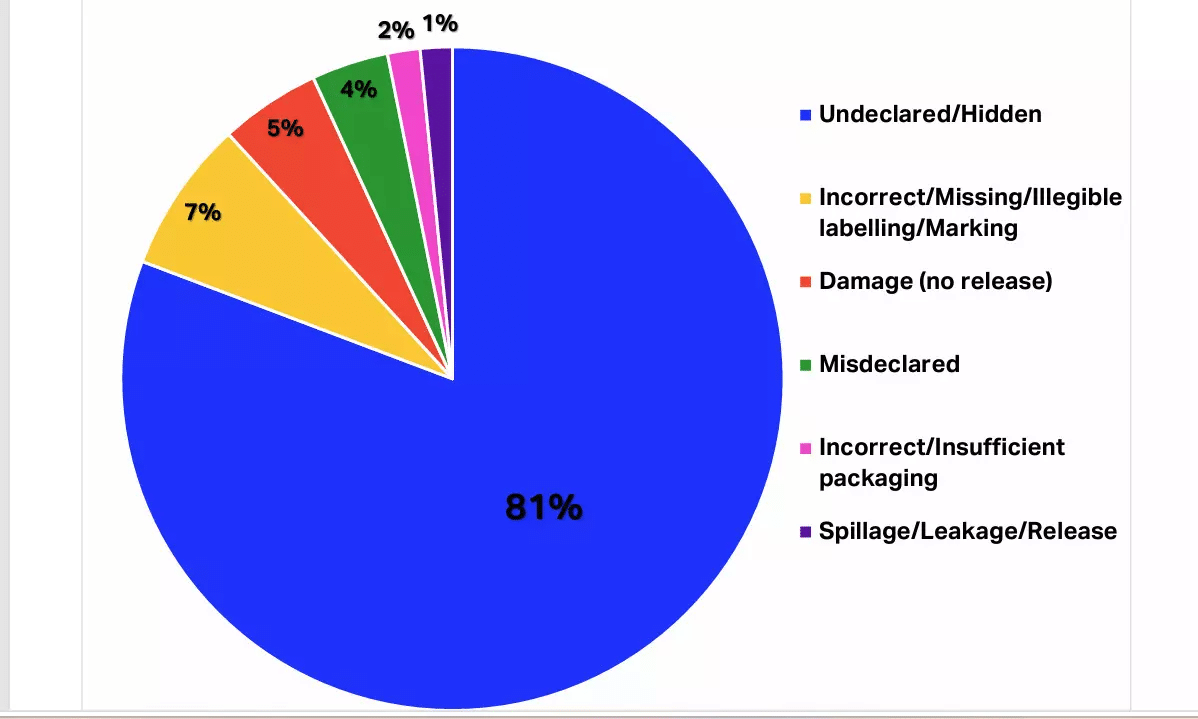
The association said that around 80% of dangerous-goods incidents reported to IATA during the first half of 2025 involved undeclared or hidden dangerous goods. Lithium batteries were among the commodities most frequently identified, alongside other concealed hazardous products including e-cigarettes and aerosols.




Dangerous goods are routinely transported safely
The presence of dangerous goods in the air cargo system is not, in itself, an indication of non-compliance.
Thousands of dangerous goods shipments move by air every day under established international regulations and handling procedures. IATA’s position is that the principal concern arises when regulated commodities enter the supply chain undeclared, incorrectly declared or outside the controls required for safe transport.
The international framework for dangerous goods transport is built around ICAO Annex 18 and the ICAO Technical Instructions, supported by industry requirements including the IATA Dangerous Goods Regulations.
The regulatory system covers a broad range of commodities, from explosives and flammable materials to corrosives, radioactive substances and lithium batteries.
IATA’s 2026 Battery Shipping Regulations guidance states that lithium and sodium-ion batteries are classified as dangerous goods for air transport because of the potential for thermal runaway. While certain batteries may qualify for provisions that reduce specific documentation or labelling requirements, they remain subject to applicable dangerous-goods requirements.
Lithium batteries remain a particular concern
The growth in battery-powered consumer electronics, mobility products and other technology is increasing the volume of lithium batteries moving through global logistics networks.
IATA reported that the number of lithium batteries transported as air cargo increased 25% year on year, while incidents involving overheating power banks and other battery-related risks have contributed to changes in the industry’s dangerous-goods requirements.
The association has separately identified the carriage of misdeclared or undeclared high-energy storage devices as a high-consequence hazard. Lithium-ion batteries can undergo thermal runaway, potentially producing fire, smoke and toxic gases and creating serious challenges for aircraft crews and ground personnel.
The concern is therefore not simply the presence of batteries in the cargo system, but whether shipments have been correctly identified, classified, packaged, documented, marked and presented for transport.
Recent US enforcement case illustrates the risk
A March 2026 enforcement action by the US Federal Aviation Administration (FAA) provides a recent example of the potential consequences of non-compliant lithium-battery shipments.
The FAA proposed a $260,000 civil penalty against World Event Promotions (WEP) of Coral Gables, Florida, alleging violations of hazardous-materials regulations involving three shipments of battery packs containing lithium-ion batteries offered to UPS for air transportation.
In one case, employees at a UPS sorting facility in Ontario, California, discovered that the shipment was smoking and that the package had developed a burn hole.
According to the FAA, the shipments were not accompanied by the required shipping documentation and were not properly classified, described, packaged, marked or labelled. The agency also alleged that the batteries were offered for transportation with a state of charge exceeding 30% of their rated capacity and that required emergency-response information was not provided.
The allegations remain allegations under the FAA enforcement process; WEP was given 30 days to respond to the agency’s enforcement letter.
The case demonstrates why accurate declaration and preparation remain critical before dangerous goods enter an air cargo network.
Security screening has limitations
IATA’s latest white paper also addresses the relationship between aviation security screening and dangerous-goods safety.
Existing cargo security screening systems are primarily designed to identify explosives and other security threats. They can provide an additional opportunity to identify some undeclared dangerous goods, but IATA says they were not designed to detect the full range of hazardous commodities.
That distinction is important as regulators and industry consider how existing screening systems should respond to the growing problem of undeclared dangerous goods.
IATA argues that simply increasing screening could also create operational consequences. Greater detection may result in more shipments being stopped for additional examination, potentially increasing inspection volumes, creating false alarms and putting additional pressure on cargo-handling resources.
For airports, handlers, airlines and freight forwarders, the challenge is therefore to improve detection without creating unnecessary bottlenecks in the cargo system.
A multi-layered supply-chain response
IATA’s proposed approach places responsibility across the entire cargo ecosystem rather than relying principally on airport screening.
The association is calling for:
- Governments to strengthen oversight and enforcement of dangerous-goods requirements.
- Manufacturers and online marketplaces to improve product identification, certification where required and the accuracy of product information.
- Shippers, freight forwarders and postal operators to strengthen training, acceptance controls and the use of customer and shipment data to identify higher-risk cargo.
- Airlines and ground handlers to reinforce checks before cargo is loaded.
- Airports to improve coordination and information sharing across the cargo community.
This approach recognises that dangerous goods can enter the logistics chain at multiple points and that weaknesses in information, declaration or acceptance procedures can persist until cargo reaches an airport.
Brendan Sullivan, IATA’s Global Head of Cargo, said security screening should be regarded as one layer of protection rather than a complete solution.
“Every part of the supply chain has a role to play in identifying and stopping such incidents as soon as possible.”
E-commerce adds another layer of complexity
The expansion of e-commerce has made the identification and declaration of dangerous goods more challenging because cargo can originate from a much larger and more diverse group of shippers.
Online marketplaces and manufacturers may have detailed information about product composition, but that information does not necessarily move seamlessly through every stage of the logistics chain.
IATA’s recommendations therefore place greater emphasis on accurate product information upstream, before shipments reach freight forwarders, postal operators, ground handlers or airlines.
For logistics providers, the objective is not simply to identify dangerous goods at the airport but to establish stronger controls at the point where cargo enters the supply chain.
Balancing safety with cargo efficiency
As screening technology, data analytics and detection systems become more sophisticated, the industry is likely to gain additional tools for identifying suspicious or incorrectly declared shipments.
However, increased detection also creates an operational question: how should the industry manage the additional cargo that requires intervention?
A system that produces large numbers of alerts without adequate processes for verification could increase inspection workloads, slow cargo throughput and consume resources that are needed elsewhere in the supply chain.
IATA’s position is consequently centred on risk management rather than universal physical inspection. The objective is to combine information, training, acceptance procedures, targeted screening and regulatory oversight to reduce risk while maintaining efficient cargo flows.
Industry responsibility extends beyond the airport
The latest IATA initiative reinforces a broader shift in the way dangerous-goods safety is being considered.
Rather than treating cargo screening as the primary point of defence, the association is calling for a system in which manufacturers, marketplaces, shippers, forwarders, postal operators, handlers, airlines, airports and regulators each contribute to identifying and managing dangerous goods.
IATA has also called for modernisation of dangerous-goods safety frameworks to reflect increasingly digital and fast-moving supply chains and emerging risks involving undeclared dangerous goods and lithium batteries.
For the air cargo industry, the issue is ultimately one of maintaining the balance between safety, security, compliance and operational efficiency. As cargo networks become more complex and shipment volumes continue to expand, the ability to identify dangerous goods accurately before they enter the aviation system will remain a critical part of safe air transport.