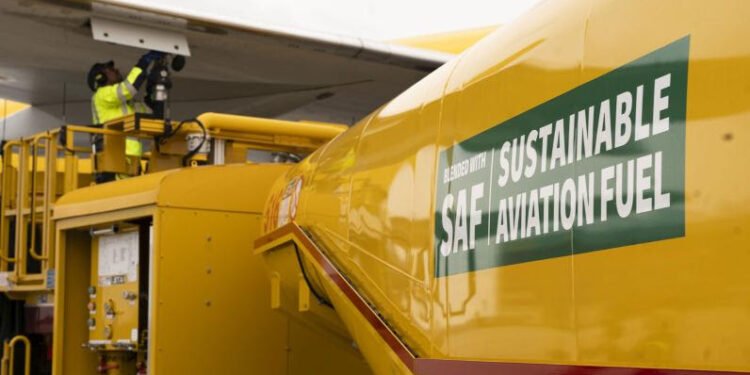


Singapore has launched a voluntary pilot programme to test a centralised procurement model for Sustainable Aviation Fuel (SAF), bringing together a coalition of aviation, financial and corporate stakeholders to prepare for the city-state’s upcoming mandatory SAF blending policy.
The initiative is led by the Civil Aviation Authority of Singapore (CAAS) and the newly established Singapore Sustainable Aviation Fuel Company Ltd. (SAFCo). Memoranda of understanding with participating organisations were signed during the Changi Aviation Summit, marking a significant step in Singapore’s strategy to reduce aviation emissions while strengthening its role as a regional hub for sustainable aviation fuel.
Pilot to Test National SAF Procurement Framework
The pilot programme is designed to evaluate the operational, commercial and accounting systems required to support a national-scale SAF purchasing model.
Related Post




Under the proposed framework, SAFCo will act as a centralised procurement platform, aggregating demand from airlines, corporate buyers and financial institutions to negotiate SAF supply and manage the allocation of associated environmental attributes.
These environmental attributes represent the verified carbon dioxide emissions reductions achieved when SAF is used in place of conventional jet fuel.
By consolidating demand, Singapore aims to reduce administrative complexity and transaction costs while improving price transparency across the SAF supply chain—an important consideration given the current price premium associated with sustainable aviation fuels.
Broad Industry Participation
Nine major organisations from aviation, finance and consulting sectors are participating in the voluntary trial. The companies involved include:
- Boston Consulting Group
- Changi Airport Group
- DBS Bank
- GenZero
- OCBC Bank
- Temasek
- Singapore Airlines
- Scoot
Through the pilot, these organisations will work with SAFCo to explore procurement of SAF and the accounting mechanisms required to track emissions reductions linked to fuel usage.
Officials say the trial will provide participants with practical experience in sourcing and reporting SAF consumption within a centralised purchasing system.
Preparing for Mandatory SAF Blending
The initiative serves as a precursor to Singapore’s mandatory SAF policy, which will come into force on 1 October 2026.
Under the regulation, all flights departing Singapore will be required to incorporate at least 1 percent SAF in their fuel mix, representing one of the first nationwide SAF mandates in Asia.
To support the policy, the government plans to introduce a SAF levy on departing flights. Revenue from the levy will be channelled through SAFCo, which will procure SAF on behalf of airlines and distribute the fuel within the national aviation system.
Authorities believe the centralised purchasing model will simplify procurement for airlines and enable more efficient scaling of SAF adoption.
Addressing the Cost Challenge
Despite its environmental benefits, the widespread adoption of SAF has been slowed by cost barriers. Industry estimates indicate that SAF can currently cost more than twice as much as conventional jet fuel, depending on feedstock, production technology and supply chain factors.
By aggregating demand through SAFCo, Singapore aims to strengthen purchasing power and create clearer price signals for fuel producers, potentially encouraging greater investment in SAF production capacity.
The model could also improve transparency in pricing and reduce the complexity associated with individual bilateral purchasing agreements between airlines and fuel suppliers.
Supporting a Regional SAF Ecosystem
The pilot programme forms part of Singapore’s broader strategy to position itself as a regional hub for sustainable aviation fuel development and distribution.
Previous national initiatives have included SAF demonstration flights, supply chain feasibility studies and partnerships with international fuel producers.
With the introduction of centralised procurement and a national blending mandate, Singapore hopes to stimulate both local demand and regional supply, contributing to the long-term development of a scalable SAF market across Asia-Pacific.
Industry observers note that if the model proves successful, it could serve as a blueprint for other aviation hubs seeking to accelerate SAF adoption while managing cost and operational complexity.
As global aviation works toward its net-zero emissions targets, initiatives such as Singapore’s centralised SAF procurement system may play a critical role in bridging the gap between sustainability commitments and large-scale commercial implementation.