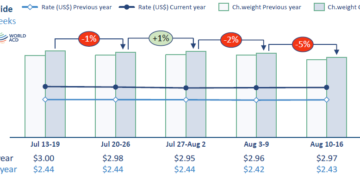
Air cargo demand between Asia Pacific and Europe weakened sharply in early July, with new European Union customs measures and weather-related disruptions contributing to a significant decline in volumes across key export markets, according to the latest data from WorldACD Market Data.
Figures for Week 28 (6–12 July) show that air cargo volumes from the Asia Pacific region to Europe fell 10% week on week and 15% year on year, reflecting softer demand across major e-commerce export hubs and the early impact of new EU import rules.
The steepest decline was recorded in Hong Kong, where chargeable weight to Europe dropped 23% year on year after four consecutive weeks of falling volumes. According to WorldACD, the downturn coincided with the European Union’s removal of the de minimis import tariff exemption and the introduction of a temporary €3 customs handling fee on low-value parcels imported from outside the bloc from 1 July. The changes are expected to remain in place until the EU Customs Data Hub becomes operational in 2028.
Related Post


WorldACD said the decline in Hong Kong-Europe traffic “reflects the impact of the removal by the EU of de minimis import tariff exemptions since 1 July,” highlighting the sensitivity of cross-border e-commerce flows to regulatory changes.
Mainland China, another major e-commerce export market, also registered weaker demand. Shipments to Europe fell 13% week on week and 15% year on year, indicating that the slowdown extended beyond Hong Kong and affected the broader regional market.
The latest figures come after global e-commerce supply chains adjusted to earlier policy changes in the United States. Following the removal of the US de minimis exemptionfor goods originating from China and Hong Kong, trans-Pacific air cargo volumes initially declined as capacity shifted towards Europe. Although China-US traffic later recovered, the latest EU regulatory changes appear to be creating fresh headwinds for Asia-Europe trade.
Elsewhere in the region, Taiwan recorded one of the sharpest weekly declines, with cargo volumes to Europe falling 24% week on week.
WorldACD attributed part of the weakness to Typhoon Bavi, which disrupted air cargo operations across East Asia. The market intelligence provider said the storm had a particularly strong impact on cargo capacity and chargeable weight from Taiwan, while also affecting flight capacity and shipment volumes from China and other parts of the region.
The combination of regulatory changes and operational disruptions underscores the growing volatility facing the Asia-Europe air cargo market. With e-commerce continuing to account for a significant share of cross-border air freight, industry participants are closely monitoring whether the latest customs reforms will lead to longer-term shifts in sourcing patterns, shipping strategies and network capacity.