
New customs regulations and the removal of the de minimis exemption weigh heavily on e-commerce shipments, while transpacific trade remains resilient.
Air cargo traffic from Hong Kong to Europe has fallen sharply following the European Union’s introduction of new import regulations on 1 July 2026, with freight volumes declining by more than 20% in recent weeks as e-commerce shipments adjust to the revised customs framework.
According to the latest weekly market analysis from WorldACD Market Data, chargeable weight from Hong Kong to Europe declined by a further 5% week-on-week during Week 29 (13–19 July), marking the fifth consecutive weekly decline. Compared with the same week in 2025, volumes were down 24%, while average tonnage during Weeks 26 to 29 fell 18% year-on-year, based on data covering more than 500,000 weekly air cargo transactions.
EU Customs Changes Reshape Cargo Flows
The sharp decline coincides with the implementation of new EU import rules that eliminated the long-standing de minimis exemption for consignments valued below €150.
Under the revised regulations, low-value shipments entering the European Union are now subject to a fixed €3 charge per item, alongside enhanced customs reporting requirements.
Hong Kong has experienced the most significant impact due to its heavy reliance on cross-border e-commerce traffic, which has traditionally accounted for a substantial share of outbound air cargo destined for European consumers.
Mainland China also recorded weaker demand, with cargo volumes to Europe declining 2% week-on-week in Week 29 after falling 9% the previous week. Compared with the same period last year, Chinese exports to Europe were down 10%, while average volumes across Weeks 26 to 29 declined 8% year-on-year.
Combined cargo volumes from China and Hong Kong to Europe contracted 11% during the four-week period, contrasting with 5% growth recorded across the rest of the global air cargo market.
Wider Impact Across Asia-Pacific
The regulatory changes have also affected several other export markets across Asia-Pacific.
In Week 29, air cargo volumes to Europe from Vietnam declined 9% year-on-year, while shipments from Thailandfell 11%.
Overall, chargeable weight from the Asia-Pacific region to Europe dropped 13% year-on-year during both Weeks 28 and 29, with the downturn largely driven by weaker exports from China and Hong Kong.
The figures underline the sensitivity of e-commerce-driven air cargo flows to regulatory changes, particularly in markets where low-value consumer goods represent a significant proportion of exports.
Transpacific Market Remains Stable
In contrast to the European market, air cargo demand between China, Hong Kong and the United States remained comparatively resilient.
Cargo volumes from China to the U.S. increased 19% year-on-year in Week 29, while Hong Kong shipments rose 8%. Combined volumes from Asia-Pacific to the United States increased 3% week-on-week and were 15% higherthan the previous year.
The year-on-year gains partly reflect weaker comparison figures from 2025, when U.S. imports from China and Hong Kong declined following changes to American de minimis import rules introduced last year.
Taiwan also contributed to the recovery, with cargo volumes rebounding 32% week-on-week after flight disruptions caused by Typhoon Bavi affected operations during Week 28.
Spot Rates Ease on Europe Routes
Freight rates from Asia-Pacific to Europe continued to soften as cargo demand weakened.
Spot rates from China to Europe declined for a fourth consecutive week, falling 5% to an average of US$4.17 per kilogram during Week 29.
Although rates remain 8% higher than a year earlier, largely due to elevated fuel costs and surcharges linked to geopolitical tensions in the Middle East, the premium over 2025 levels has narrowed considerably. Two months ago, spot prices were between 30% and 40% higher than the previous year.
Average spot rates across Asia-Pacific to Europe stood at US$4.63 per kilogram, remaining 20% above last year’s level.
Meanwhile, rates to the United States remained firm at US$6.61 per kilogram despite modest declines from China and Hong Kong, supported by higher prices from South Korea and Taiwan. Overall, Asia-Pacific to U.S. spot rates were 36% higher year-on-year, reflecting sustained demand, constrained capacity and increased fuel surcharges.
Global Air Cargo Market Holds Steady
Despite regional volatility, the broader air cargo market remained relatively stable.
Worldwide cargo tonnage was unchanged week-on-week during Week 29, as stronger exports from Asia-Pacific offset weaker demand in other regions. Globally, air cargo volumes increased 3% year-on-year, with Asia-Pacific exports rising 6%.
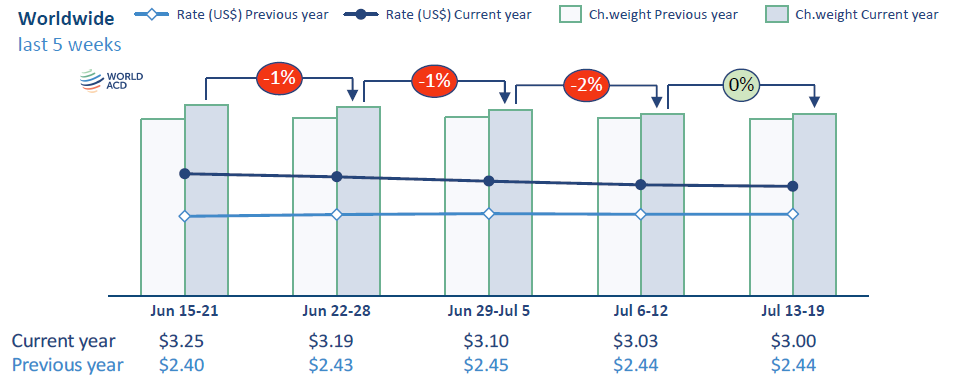
Average global freight rates eased slightly to US$3.00 per kilogram, down 1% week-on-week but still 23% higherthan a year earlier. Global spot rates edged up to US$3.46 per kilogram, with Africa recording the strongest weekly increase.
Air cargo capacity also improved modestly, rising 1% week-on-week and standing 3% above pre-conflict levels recorded before the outbreak of the recent U.S.-Iran conflict. However, capacity serving the Middle East and South Asia remains constrained, with available lift still 13% below pre-conflict levels and Gulf market capacity down by approximately 22%.
The latest market data highlights how regulatory changes, geopolitical uncertainty and evolving trade patterns continue to reshape global air cargo flows, particularly for e-commerce shipments that have become a major driver of international freight demand.