
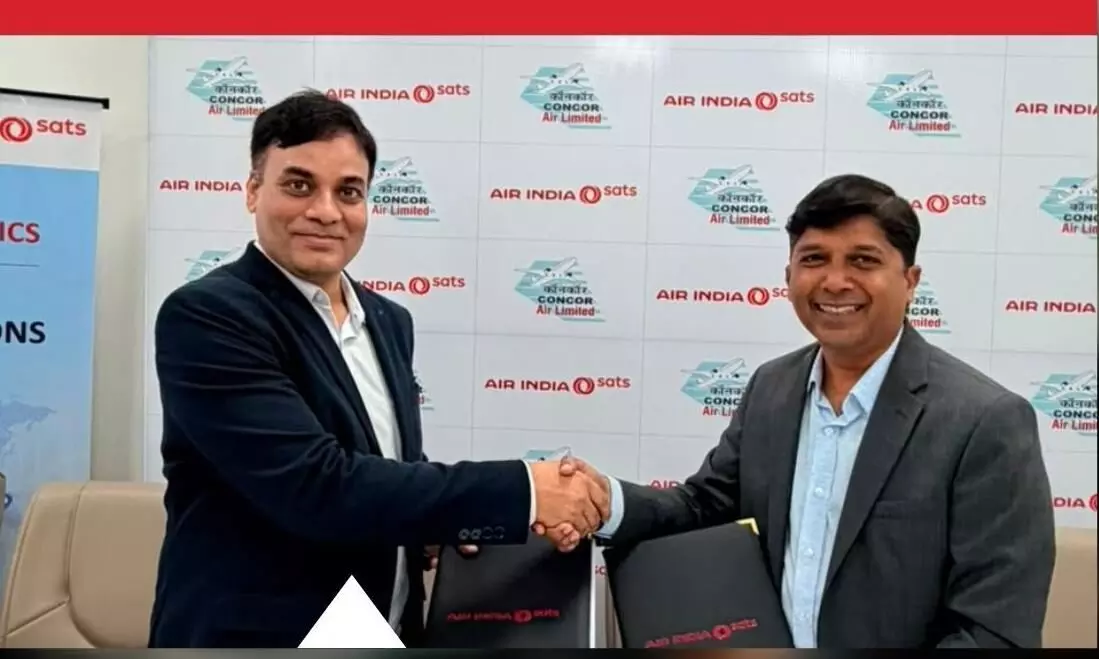
- AISATS and CONCOR Air have signed an MoU to facilitate the movement of customs-cleared transhipment cargo from CONCOR’s Inland Container Depot at Dadri to the AISATS Integrated Cargo Terminal at Noida International Airport.
- The partnership is designed to create a more streamlined connection between inland containerised cargo and air freight infrastructure, potentially reducing handling interfaces and improving cargo movement into global markets.
- The agreement strengthens the role of Noida International Airport and AISATS’ integrated cargo hub as part of a wider multimodal logistics ecosystem serving the Delhi-NCR and northern Indian market.
AISATS, CONCOR Air connect Dadri ICD with Noida International Airport
AISATS and CONCOR Air have signed a Memorandum of Understanding aimed at strengthening the connection between India’s inland container network and its emerging international air cargo infrastructure.
Under the agreement, customs-cleared transhipment cargo handled at the Container Corporation of India (CONCOR) Inland Container Depot (ICD) at Dadri will be moved to the AISATS Integrated Cargo Terminal at Noida International Airport.
The arrangement is intended to provide a more direct and coordinated movement channel between the inland logistics network and the airport, supporting the transfer of eligible cargo from Dadri into the international air freight system.
The agreement is particularly significant for the Delhi-NCR region, where Dadri has developed into an important inland logistics location and Noida International Airport is being positioned as a major new aviation and cargo gateway.
Linking inland cargo with air freight infrastructure
The new arrangement addresses an increasingly important requirement in India’s logistics sector: connecting inland cargo infrastructure with international air freight networks through more efficient multimodal processes.
Dadri ICD already serves export, import and domestic cargo requirements across a broad catchment area covering Uttar Pradesh, Haryana, Uttarakhand, Himachal Pradesh and Delhi-NCR. CONCOR describes the Dadri facility as a strategically located inland container terminal serving a substantial regional trade base.
The new AISATS-CONCOR Air arrangement adds an air cargo dimension to that inland network.
Once customs-cleared transhipment cargo reaches the airport, it can enter AISATS’ cargo-handling infrastructure at Noida International Airport for onward air transportation.
The objective is to create a smoother transition between inland surface logistics and international aviation, potentially improving transit times and reducing unnecessary cargo-handling interfaces.
AISATS’ integrated cargo hub at Noida
The agreement also gives greater strategic relevance to AISATS’ developing cargo infrastructure at Noida International Airport.
AISATS describes its Multi-Modal Cargo Hub (MMCH) at Noida as an integrated facility combining an Integrated Cargo Terminal (ICT) with an Integrated Warehousing and Logistics Zone (IWLZ). The two components are being developed within the same zone to create operational synergies and improve cargo-handling efficiency.
The facility is intended to provide an integrated platform for cargo handling, warehousing and logistics activities.
For AISATS, connecting the airport terminal with an established inland cargo location such as Dadri expands the potential catchment area of the Noida air cargo operation.
Instead of relying solely on cargo originating close to the airport, the facility can be connected to wider inland supply chains across northern India.
CONCOR brings established inland connectivity
CONCOR’s involvement provides the partnership with access to an established multimodal logistics network.
The state-owned logistics company operates a nationwide network of inland and export-import terminals and describes itself as India’s largest container train operator.
Dadri is one of its important northern terminals.
The facility has established connections with India’s major western ports, including Mundra, Pipavav and Jawaharlal Nehru Port, while double-stack container train operations have strengthened its rail connectivity. CONCOR has previously reported that double-stack services between Dadri and Mundra reduced transit time substantially compared with earlier operations.
The new air cargo link therefore adds another transport option to an already diversified inland logistics network.
Customs-cleared transhipment is central to the agreement
A key element of the MoU is the movement of customs-cleared transhipment cargo.
By focusing on cargo that has completed the relevant customs process, the partners are seeking to establish a predictable transfer mechanism between Dadri and the airport.
The approach could help cargo move through the inland-to-air interface with fewer operational interruptions, particularly where shipments are time-sensitive.
For exporters and logistics providers, predictability can be as important as speed.
The ability to coordinate customs, inland transportation, cargo acceptance and airport handling as part of a connected process can reduce uncertainty and make air freight more attractive for time-critical shipments.
Multimodal logistics gains importance in India
The partnership comes as India places increasing emphasis on building a more integrated multimodal logistics system.
The country’s logistics strategy is increasingly focused on connecting road, rail, inland terminals, ports, airports and warehousing infrastructure rather than treating each mode as an independent network.
Air cargo can play a particularly important role in this system for high-value and time-sensitive commodities.
Electronics, pharmaceuticals, precision engineering products, perishables, express shipments and other premium cargo often require faster transportation than conventional ocean or rail services can provide.
Connecting inland container terminals directly with international airports can therefore broaden the geographic reach of air freight.
Noida emerges as a new northern cargo gateway
The agreement also reinforces the strategic importance of Noida International Airport as a new cargo gateway for northern India.
AISATS already lists Noida among its cargo operations locations and is developing the integrated cargo hub specifically to combine airport cargo handling with warehousing and logistics capabilities.
The airport’s location in the Delhi-NCR region places it close to one of India’s largest concentrations of manufacturers, exporters, importers, e-commerce companies and distribution centres.
The challenge for any new cargo gateway is not simply attracting aircraft capacity but building the supporting logistics ecosystem around the airport.
Connections with inland terminals such as Dadri are therefore strategically important.
A broader catchment area for international air cargo
The Dadri-Noida connection could allow cargo originating farther from the airport to access international air services through a dedicated inland-to-air movement process.
This could be particularly useful for exporters in industrial clusters across northern India.
Dadri’s established role as an inland container location provides an existing cargo aggregation point, while Noida International Airport offers access to the international air freight network.
Together, the two facilities create the foundations for a multimodal corridor in which cargo can transition from inland logistics infrastructure to air transport without requiring exporters to manage multiple disconnected processes.
Senior executives attend signing
Senior executives from both organisations and their parent groups attended the signing ceremony.
Participants included Bob Chi, CEO, Gateway Services, Asia-Pacific; Ramanathan Rajamani, CEO, AISATS; Salim Chaudhary, Chief Operations Officer, AISATS; Vikas Agarwal, Chief Financial Officer, AISATS; Vijoy Kumar Singh, Director (International Marketing & Operations, Projects & Services), CONCOR; Narmadeshwar Jha, CEO, CONAIR Ltd.; and Vivek Gupta, Director (Finance), CONCOR.
The participation of senior leadership from AISATS, CONCOR and CONCOR Air underlines the strategic importance attached to strengthening the interface between inland and airport cargo networks.
AISATS itself is a 50:50 joint venture between Air India and SATS, with operations spanning passenger, ramp and cargo handling services across multiple Indian airports.
Building a more connected cargo value chain
For AISATS, the agreement supports its ambition to develop Noida into an integrated cargo and logistics platform.
For CONCOR Air and CONCOR, it creates another pathway through which inland cargo can access India’s expanding air freight infrastructure.
The broader objective is to improve speed, efficiency and connectivity across the cargo value chain.
Such connections are increasingly important as India’s international trade volumes grow and manufacturers seek logistics solutions that can move goods efficiently between production centres and overseas markets.
Potential benefits for exporters and freight forwarders
The new corridor could offer several potential advantages to cargo owners and logistics providers:
- Improved inland-to-air connectivity between Dadri and Noida.
- Fewer handling interfaces between the inland terminal and airport cargo facility.
- Greater access to international air freight capacity for northern Indian exporters.
- Potentially faster transit for time-sensitive cargo.
- Closer integration of customs, surface transportation and airport handling.
- Greater multimodal flexibility for freight forwarders and cargo owners.
The ultimate benefit will depend on how the operational model is implemented, including schedules, cargo volumes, customs procedures and onward airline connectivity.
Strengthening India’s multimodal cargo ambitions
The AISATS-CONCOR Air agreement illustrates how India’s air cargo development is increasingly being linked to the country’s wider multimodal logistics strategy.
The development of new airports alone does not automatically create an efficient cargo ecosystem. Their success depends on strong connections with manufacturing clusters, inland container depots, warehouses, road and rail networks and customs infrastructure.
Dadri and Noida provide an example of how those components can be connected.
With CONCOR’s established inland network on one side and AISATS’ integrated air cargo infrastructure on the other, the partnership creates a framework for moving customs-cleared cargo from an inland logistics node into the international air freight network.
As India’s exporters increasingly compete on delivery speed as well as product cost, such connections could become an important part of the country’s next phase of cargo infrastructure development.