
- CargoPoint has opened a new office in Almaty, Kazakhstan, strengthening its Central Asian footprint and expanding its China-Europe Truck+Air multimodal network.
- The company will route consolidated cargo from Shenzhen and Xi’an by road through Khorgos into Kazakhstan, before connecting shipments by air from Almaty and Astana to Europe and other international markets.
- CargoPoint says the route can cut China-Europe transit times by at least two days, combining the cost advantages of road freight with the speed of air cargo as shippers seek alternatives to disrupted maritime and traditional rail corridors.
CargoPoint strengthens China-Europe corridor with Almaty expansion
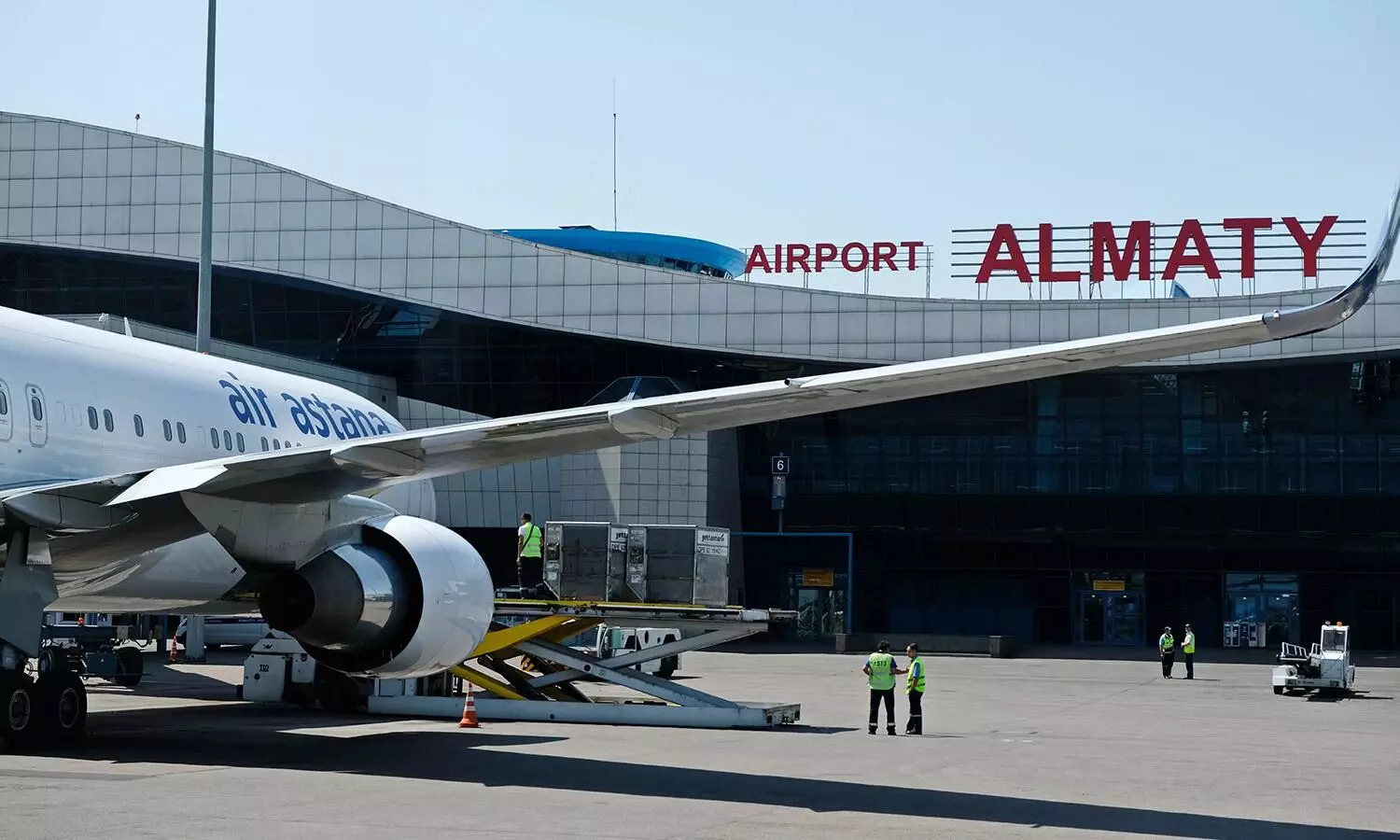
CargoPoint has expanded its Central Asian operations with the opening of a new office in Almaty, Kazakhstan, as the freight forwarder seeks to strengthen its China-Europe multimodal network and provide shippers with additional alternatives for moving cargo between Asia and Europe.
The new office gives CargoPoint a dedicated operational presence in Kazakhstan, an increasingly important transit point for freight moving west from China through Central Asia.
The expansion is centred on the company’s Truck+Air solution, which combines road transportation across Central Asia with onward air freight connections to international destinations.
Related Post




CargoPoint says the model provides an alternative to conventional China-Europe supply chains by balancing transit speed and transportation cost.
Road from China, air from Central Asia
Under the Truck+Air model, cargo consolidated in Shenzhen and Xi’an is transported overland to the Chinese-Kazakh border at Khorgos.
From there, shipments continue into Kazakhstan before being transferred to air cargo services operating from Almaty and Astana.
Cargo can subsequently be connected to destinations across Europe, the Middle East, Africa and the Americas, giving shippers access to a broader international distribution network.
CargoPoint says the route can reduce China-Europe transit times by at least two days, depending on the specific origin, destination and routing.
The company describes the service as a “deferred” air freight model, in which the road leg provides a lower-cost alternative for the initial portion of the journey while air freight is used for the longer international connection.
Almaty becomes a strategic gateway
The decision to establish a permanent office in Almaty reflects the growing importance of Kazakhstan within CargoPoint’s China-Europe network.
Previously, the corridor was coordinated primarily from CargoPoint’s headquarters in Tashkent, Uzbekistan.
With the Almaty operation now in place, the company will divide responsibility for the corridor between its Uzbekistan and Kazakhstan teams.
Shipments moving through Uzbekistan will be managed by the Tashkent team, while cargo routed through Kazakhstan will be handled locally by the Almaty operation.
This structure is intended to give CargoPoint greater operational control over individual routes while improving coordination with local partners, carriers and customers.
Building resilience into China-Europe logistics
The expansion comes against a backdrop of continuing disruption and uncertainty across international supply chains.
Shippers moving cargo between China and Europe have increasingly sought alternatives to traditional routes because of congestion, geopolitical risks, changes to shipping schedules and disruption affecting maritime and air networks.
CargoPoint believes its Truck+Air model can provide an additional option by combining different transport modes rather than relying entirely on a single corridor.
Road transportation provides flexibility across the China-Central Asia section, while air freight from Kazakhstan provides a faster connection into Europe and other global markets.
The model is therefore positioned between conventional road or rail freight and premium end-to-end air cargo.
Cost and speed in the same supply chain
CargoPoint’s “deferred” air freight concept is designed around the trade-off between cost and transit time.
Using air freight for the entire China-Europe journey can provide the fastest transit but carries a substantially higher transportation cost.
Conversely, rail and maritime services can offer lower costs but may involve longer transit times or greater exposure to congestion and geopolitical disruption.
The Truck+Air model uses road freight for the initial China-Central Asia movement and air cargo for the international leg.
For shippers with a requirement for faster delivery than conventional surface transport but without the cost of full-route air freight, the combination can provide another logistics option.
Bahtiyar Nomozbaev: a new artery for East-West trade
CargoPoint CEO Bahtiyar Nomozbaev said the integration of Almaty into the company’s China-Europe network was intended to strengthen a critical trade corridor.
He said the company’s objective was to provide shippers with a resilient and high-speed alternative to traditional maritime routes and help maintain the flow of East-West trade despite changing geopolitical conditions.
The comments reflect a broader shift among freight forwarders towards developing multi-route and multi-modal networks capable of responding to sudden changes in international trade flows.
Rather than relying on one primary route, logistics providers are increasingly building several alternative pathways between major production and consumption markets.
Local presence to improve operational control
CargoPoint Business Development Director Mirzali Mirusmonov said the Almaty investment should be viewed as an extension of the company’s existing network rather than an entry into an entirely new market.
The company already operates across Central Asia, but the new office is expected to provide greater control over the Kazakhstan section of the China-Europe corridor.
Having personnel on the ground can allow CargoPoint to coordinate shipments more closely with local handling and transportation partners and respond more quickly when operational conditions change.
The company also expects the Almaty operation to improve scalability as volumes increase.
Kazakhstan’s growing role in China-Europe trade
Kazakhstan occupies a strategically important position between China and Europe, sitting at the intersection of major East-West trade corridors.
The country’s geographic position makes it an important transit market for cargo moving westward from China through Central Asia.
Khorgos, on the Kazakhstan-China border, has developed into a major logistics and trade gateway, connecting Chinese supply chains with Central Asian and European markets.
For multimodal operators such as CargoPoint, Kazakhstan provides the opportunity to combine road and air infrastructure while avoiding some of the constraints associated with longer maritime or rail routes.
The Almaty hub therefore forms part of a wider evolution in Central Asian logistics, in which airports, road corridors, rail terminals and border crossings are increasingly being integrated into alternative Asia-Europe supply chains.
Almaty and Tashkent to work as a single corridor
CargoPoint will now operate the China-Europe network through two Central Asian bases.
The Tashkent office will continue to manage shipments moving through Uzbekistan, while the Almaty office will oversee Kazakhstan-based routings.
This dual-gateway approach gives the forwarder greater flexibility when selecting routes according to cargo requirements and operating conditions.
It also creates the potential to shift volumes between Central Asian gateways when capacity, border conditions or customer requirements change.
For shippers, the ability to access more than one regional gateway can be an important component of supply chain resilience.
Expanding beyond China-Europe
Although China-Europe freight is at the centre of the Almaty expansion, CargoPoint’s air connections extend beyond Europe.
The company plans to use air capacity from Almaty and Astana to connect cargo with markets in the Middle East, Africa and the Americas.
This potentially transforms the Kazakhstan operation from a China-Europe transit point into a broader Central Asian gateway for international cargo.
As volumes develop, the office could therefore support a wider range of trade lanes rather than being limited to the original China-Europe corridor.
CargoPoint expects volumes to grow
The company expects cargo volumes through Almaty to increase as shippers look for alternatives to congested maritime routes and airspace affected by geopolitical disruption.
That demand could create opportunities for multimodal solutions capable of balancing reliability, transit time and cost.
CargoPoint intends to serve both existing and new customers from the Almaty office while expanding the number of routing options available through Central Asian gateways.
The company is effectively positioning the new operation as an additional layer of flexibility within its wider network.
A broader multimodal strategy
CargoPoint operates as a freight forwarder with hubs in Tashkent, Almaty, Dubai and Singapore.
Its service portfolio covers air freight, road and rail transportation, multimodal logistics, last-mile delivery and customs brokerage.
The company’s Almaty investment therefore fits within a broader strategy of combining different transport modes and regional gateways rather than focusing exclusively on conventional freight forwarding.
For China-Europe trade, that approach is increasingly relevant as companies reassess the balance between cost, speed and resilience.
Central Asia gains prominence in global freight routing
The development of CargoPoint’s Almaty hub highlights the changing geography of international logistics.
As geopolitical uncertainty, maritime disruption and changing trade patterns reshape established supply chains, Central Asia is attracting greater attention as a bridge between China and markets further west.
Kazakhstan’s location provides access to China’s western border while its road, rail and aviation infrastructure offers multiple options for onward transportation.
CargoPoint’s decision to establish a permanent operation in Almaty indicates that freight forwarders increasingly see these capabilities as part of a long-term network rather than simply contingency routes.
For shippers, the emergence of such services provides another choice between traditional surface transport and full-route air freight.
As East-West trade continues to evolve, the combination of road connectivity through Central Asia and air capacity from regional gateways could become an increasingly important component of the China-Europe logistics landscape.