
Global air cargo traffic weakened in the final week of September, while capacity remained broadly unchanged and freight rates continued to climb, according to the latest data from WorldACD Market Data.
Global chargeable weight fell 4% week on week in the period from September 21 to 27, with volumes declining from most origin regions and across the major Asia-Pacific trade lanes. The slowdown was particularly pronounced on Asia-Europe routes, while pricing moved in the opposite direction, increasing 2% globally.
Africa was the only origin region to record weekly growth, with chargeable weight rising 7%. Asia Pacific recorded the sharpest contraction, at 7%, while volumes from Europe and Central and South America each declined 1%. WorldACD attributed part of the Asia-Pacific weakness to public holidays in Japan and China during the period.
Related Post


Despite the weekly decline, global tonnage remained 5% above the corresponding week of 2025, with all major origin regions recording year-on-year growth. Africa led with a 9% increase, followed by Asia Pacific and Europe, both up 6%. MESA traffic was also 1% higher year on year despite the continuing impact of conflict in the Middle East.
Asia-Pacific traffic weakens at different speeds
Asia-Pacific exports fell 2% week on week to the US and 8% to Europe. The European decline was broad-based, with Malaysia the notable exception, recording a 20% increase after a sharp drop the previous week linked to Malaysia Day.
Japan registered the largest decline, with chargeable weight to Europe falling 40%. Vietnam, South Korea, Indonesia and Thailand recorded contractions of between 10% and 14%.
The transpacific market was more resilient. AI-related traffic helped lift volumes from Vietnam, Malaysia, Taiwan and Singapore to the US by between 6% and 12% during the week. However, Japan, South Korea, Hong Kong and Thailand all recorded weekly declines.
Despite the latest slowdown, Asia-Pacific exports to the US remained 14% above last year’s level, while traffic to Europe was 8% lower year on year.
The divergence reflects a market increasingly shaped by cargo type and destination. Technology-related shipments continue to support transpacific demand, while weaker e-commerce flows into Europe have contributed to softer westbound volumes. WorldACD has previously reported that the decline in Asia-Europe e-commerce traffic prompted carriers to redeploy freighter capacity towards the transpacific market.
MESA volumes retreat
Middle East and South Asia (MESA) traffic also weakened during the week.
Volumes from MESA to Europe declined 6% week on week, with India down 4% and Bangladesh down 5%, while Dubai remained stable. Traffic to the US fell 2%, reflecting declines from Dubai, India and Sri Lanka.
The year-on-year picture was more positive on the US trade. MESA volumes to North America were 13% higher than a year earlier, supported by growth from India and Bangladesh. By contrast, traffic to Europe was 7% lower year on year, primarily because of a 44% contraction from Dubai and a 7% decline from India.
Capacity remains broadly unchanged
While traffic slowed, global air cargo capacity remained stable for the third consecutive week.
Worldwide capacity was unchanged week on week, with a 1% increase from Africa offset by a 1% decline from Europe. Capacity from the other major origin regions was unchanged.
On a two-week comparison, the global capacity picture was similarly stable, with regional changes ranging between minus and plus 1%. Compared with the same two-week period in 2025, total capacity was 3% higher, with all major markets recording single-digit increases.
The relatively stable supply environment contrasts with the sharper movements seen earlier in the year. WorldACD’s September data showed capacity remaining broadly steady even as airlines adjusted aircraft deployment in response to changing demand patterns.
Freight rates continue to rise
Despite weaker volumes, pricing continued to move higher.
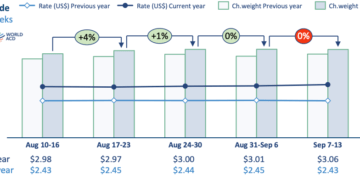
Global average airfreight rates increased 2% week on week, led by a 4% increase from Asia Pacific. Rates from Africa, Europe and MESA each rose 3%, while Central and South America recorded a 1% increase. Rates from North America were unchanged.
Compared with the same period last year, global pricing was 27% higher, with MESA recording the largest increase at 52%. Central and South America was the only origin region where year-on-year pricing growth remained below 10%.
Asia-Pacific pricing to the US was broadly unchanged week on week, as declines from six origins were offset by increases elsewhere. Rates from Asia Pacific to Europe, meanwhile, increased 2%.
The year-on-year increase was considerably stronger. Average rates from Asia Pacific to the US were 38% higher, driven by double-digit increases from several major origins, including Taiwan and Singapore. Rates from the region to Europe were 25% above last year’s level.
MESA pricing also continued to strengthen, with rates rising 3% to Europe and 7% to the US. Year on year, average rates were 63% higher on the Europe trade and 70% higher to the US.
Golden Week set to further disrupt export flows
The next major variable for the market is China’s Golden Week holiday from October 1 to 7.
The holiday is expected to temporarily disrupt production, export handovers and freight planning, potentially creating a concentrated window for shipments before and immediately after the break. WorldACD’s previous weekly analysis noted that Golden Week, following China’s Mid-Autumn Festival, was compressing production and export activity into a narrower period, while stronger general cargo demand from northern China was already emerging ahead of the holiday.
For the global air cargo market, the latest figures point to a selective rather than uniform slowdown. Demand remains above last year’s levels, technology-related shipments continue to support transpacific traffic, and capacity is relatively stable. At the same time, weaker Asia-Europe volumes and the continuing adjustment in e-commerce flows are creating significant differences between individual trade lanes.
The coming weeks will show whether Golden Week temporarily suppresses volumes or produces a stronger post-holiday rebound as exporters return to the market.