
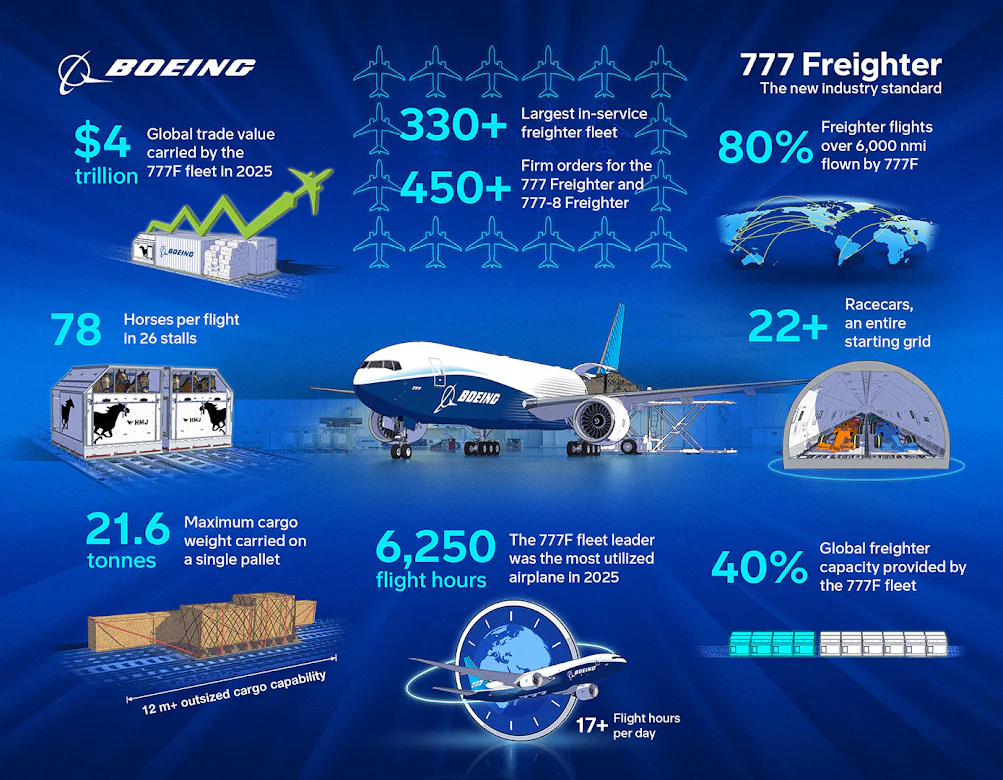
More than 330 aircraft are now in service, accounting for approximately 40% of global freighter capacity and carrying an estimated US$4 trillion in international trade during 2025. The milestone underlines the industry’s continuing transition towards large twin-engine freighters.
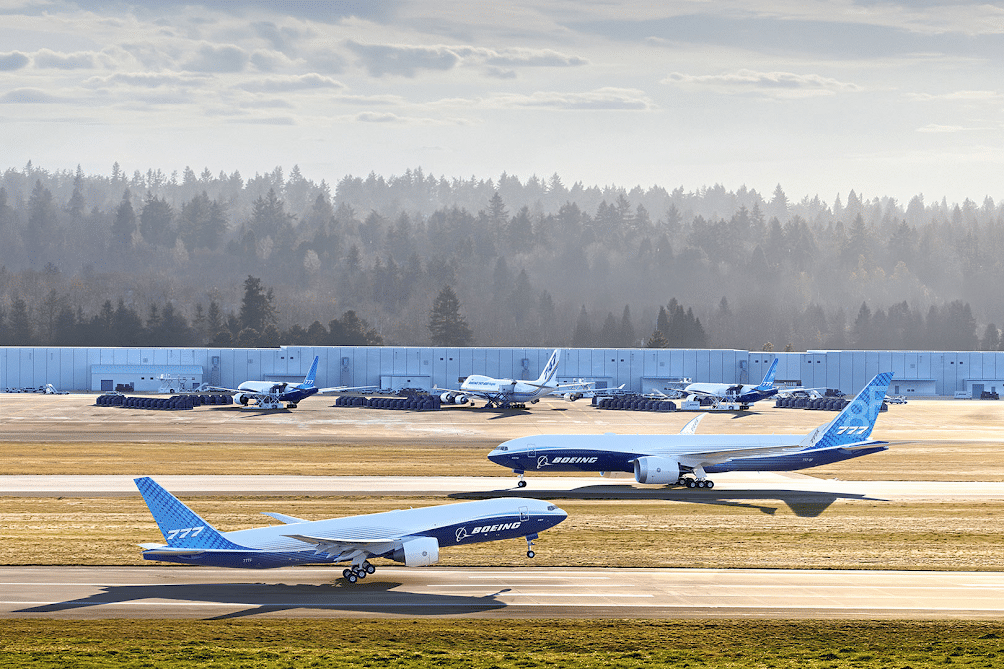
Boeing’s 777 Freighter (777F) has overtaken the 747 Freighter family to become the world’s most widely operated widebody freighter, marking a significant change in the composition of the global air cargo fleet.
According to figures released by Boeing, more than 330 Boeing 777 Freighters are now in service worldwide, exceeding the number of operational 747 freighters across all variants.
Related Post




The development represents an important milestone for the air cargo industry. For decades, the Boeing 747, widely known as the ‘Queen of the Skies’, was the dominant aircraft in long-haul freighter operations. Its large payload capacity, extensive range and nose-loading capability made it a cornerstone of international cargo transportation.
The 777F has increasingly assumed that role, benefiting from its combination of long-range performance, payload capability and twin-engine operating economics.
Boeing estimates that the aircraft now accounts for approximately 40% of global freighter capacity, reflecting its extensive deployment on international long-haul routes. The manufacturer also estimates that the worldwide 777F fleet transported goods representing approximately US$4 trillion in global trade during 2025.
Twin-engine freighters reshape the global cargo fleet
The growing prominence of the 777F reflects a broader structural shift in the air cargo industry towards large twin-engine freighters.
Airlines and cargo operators are increasingly favouring aircraft that combine substantial payload capability with improved fuel efficiency and lower operating costs compared with earlier-generation four-engine aircraft.
The 777F has become particularly important for intercontinental cargo networks, where its range and payload capabilities allow operators to serve major international trade lanes with fewer technical and operational constraints.
Boeing reports that approximately 80% of freighter flights covering more than 6,000 nautical miles are operated by the 777F, underlining its importance in long-haul cargo transportation.
The aircraft entered commercial service in 2009 and has since transported a broad range of commodities, including pharmaceuticals, electronics, fresh produce, industrial machinery and humanitarian supplies.
Significant capacity for specialised cargo
The 777F’s versatility extends beyond conventional palletised freight. Its main-deck capacity and loading configuration allow it to accommodate specialised shipments, including live animals and high-value automotive cargo.
According to Boeing, a single aircraft can transport up to 78 horses using 26 specialised stalls or more than 22 race cars, equivalent to a complete racing grid.
These capabilities demonstrate the aircraft’s suitability for a wide range of specialised logistics requirements, including motorsport transportation, equine logistics and other high-value shipments.
Boeing also highlighted the utilisation achieved by individual aircraft within the fleet. One 777F recorded 6,250 flight hours during 2025, equivalent to more than 17 hours of operation per day. This figure relates to an individual fleet-leading aircraft rather than the entire global fleet.
Boeing’s next-generation 777-8 Freighter prepares for entry
While the existing 777F continues to dominate the in-service large freighter market, Boeing is developing the next-generation 777-8 Freighter as part of its 777X programme.
The aircraft is designed to offer a maximum structural payload of approximately 118 tonnes, alongside a new composite wing and next-generation engines. Boeing has stated that it will deliver improved fuel efficiency compared with previous-generation freighters.
Boeing reports more than 450 firm orders across the 777 Freighter and 777-8 Freighter programmes combined, demonstrating continued demand for its large-capacity cargo aircraft.
However, the 777-8F programme faces a longer development timeline, with certification and delivery schedules remaining important factors for prospective operators planning future fleet investments.
Airbus A350F prepares to challenge Boeing’s market position
The changing freighter landscape is also attracting increasing competition from Airbus, whose A350F programme represents its entry into the new-generation large widebody freighter segment.
The A350F completed its maiden flight on 29 September 2026 and is progressing through its flight-test programme. Airbus has indicated that initial deliveries are targeted for the second half of 2027, subject to certification and programme progress.
According to aviation advisory firm IBA, the A350F is forecast to achieve a market value of approximately US$197 million to US$198 million when delivered in 2027, with estimated monthly lease rates between US$1.53 million and US$1.55 million.
For comparison, IBA values a newly delivered Boeing 777F in 2026 at approximately US$170 million, with monthly lease rates estimated at around US$1.35 million.
IBA’s October 2026 analysis also reported 115 firm orders for the A350F from 14 disclosed customers, compared with 89 firm orders for Boeing’s 777-8F from nine disclosed customers.
The A350F’s entry into service will introduce another option for airlines and cargo operators seeking modern, fuel-efficient widebody freighters. Its commercial performance will depend on delivery schedules, operating economics, payload capability and the ability to attract customers from established Boeing fleets.
A defining transition in air cargo aviation
The 777F overtaking the 747 marks more than a change in aircraft fleet numbers. It reflects the evolution of the global air cargo industry towards modern twin-engine aircraft capable of delivering substantial payloads over long distances.
Although the 747 will remain an important part of the cargo market through existing passenger-to-freighter conversions and dedicated freighter operations, its position as the leading widebody freighter has now been overtaken.
With the Airbus A350F entering flight testing and Boeing developing the 777-8F, the next phase of competition will increasingly focus on fuel efficiency, payload economics, fleet availability and long-term operating costs.
For airlines, freight forwarders and aircraft lessors, the emergence of these new-generation freighters will shape fleet planning and international cargo capacity for the coming decade.