
China’s low-value cross-border e-commerce exports remained under pressure in May 2026, marking six consecutive months of contraction as changing customs regulations, shifting consumer demand and evolving trade patterns reshape the global parcel logistics landscape.
According to the latest analysis by Trade and Transport Group based on China Customs data, China’s low-value e-commerce exports declined 7% year-on-year in May 2026. The latest figures continue a negative trend that began in the second half of 2025, with monthly declines ranging between 4% and 11% since September last year.
The slowdown reflects a significant shift from the rapid expansion experienced during the post-pandemic e-commerce boom. The 12-month moving average growth rate, which reached a peak of 38.3% in 2024, has flattened considerably, while cumulative exports for the January to May 2026 period registered a decline of 7.3%.



Europe and the United States Show Diverging Trends
The latest data highlights an increasingly different trajectory between the European and United States markets.
Despite the European Union’s upcoming €3-per-item customs handling charge scheduled to take effect from 1 July, there was no significant pre-implementation surge in Chinese low-value shipments. Exports to the EU declined by 32% in April, while volumes during the first five months of 2026 were down 20.4% compared with the same period last year. Market observers will closely watch June data to determine whether any last-minute increase occurred before the regulatory changes came into force.
In contrast, China-to-US low-value e-commerce shipments recorded a 26% year-on-year increase in May. However, this recovery should be viewed against a low comparison base, as May 2025 had experienced a sharp 40% decline following changes to the US de minimis exemption.
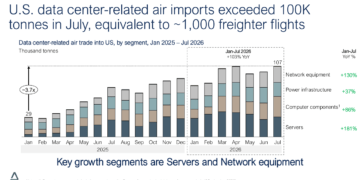
Although volumes have recovered partially, shipments remain well below levels recorded before the removal of the de minimis provision. The decline in low-value parcels has been partially offset by stronger demand for conventional air cargo, particularly high-value technology products and semiconductor-related shipments.
Asia-Pacific Continues to Lead Destination Markets
Geographically, Guangdong Province and Shanghai remain China’s largest origin points for cross-border low-value e-commerce exports. Over the past 12 months, Asia-Pacific destinations — particularly Malaysia, Singapore, Hong Kong and Japan — represented the largest share of export markets, followed by Europe and the Americas.
The evolving trade pattern demonstrates how regional diversification and premium cargo demand are increasingly influencing air cargo flows as traditional e-commerce channels adjust to new regulatory and economic realities.
Cainiao Strengthens Global Delivery Commitments
Amid the changing market environment, Cainiao has introduced new guaranteed delivery services for key international routes, transforming cross-border delivery expectations from estimated transit times to firm service commitments.
The company’s new “on-time guarantee” service covers China–US and China–Germany routes, promising delivery within 10 and eight calendar days respectively. Customers automatically receive compensation if shipments fail to meet the guaranteed delivery timeframe.
The launch follows the successful introduction of a five-day guaranteed delivery service in the United Kingdom and represents Cainiao’s first expansion of the model into the US and mainland European markets.
To further support cross-border trade and seasonal demand, the company has also introduced two dedicated US logistics services — the Priority Light Parcel Line and the California Line — designed to provide faster and more efficient transportation options for Chinese merchants. The Priority Light Parcel Line targets lightweight, high-volume parcels, while the California Line offers cost-efficient access to the US West Coast market.
As global e-commerce supply chains undergo structural change, logistics providers are increasingly focusing on service reliability, speed and specialised network solutions to remain competitive. The continued decline in low-value exports from China illustrates a broader transformation of international e-commerce flows, where regulatory shifts and changing trade patterns are redefining the future of cross-border air logistics.