
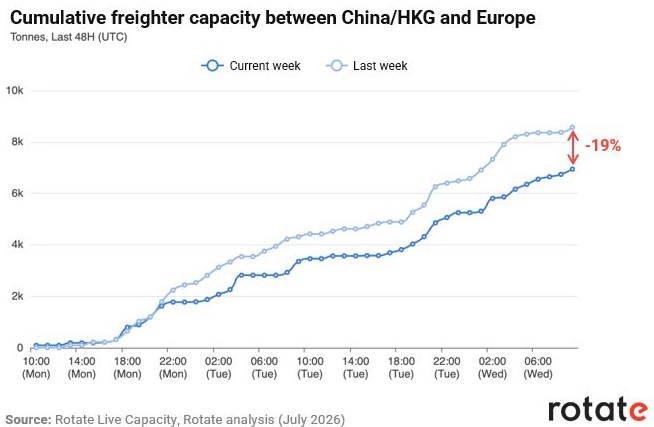
Air cargo capacity between China, Hong Kong and the European Union has fallen sharply following the introduction of the EU’s new customs charge on low-value e-commerce imports, highlighting the immediate impact of regulatory changes on cross-border air freight.
According to aviation data and consultancy firm Rotate, dedicated freighter capacity operating directly between China and Hong Kong and the European Union declined 19% week-on-week during the 48-hour period beginning on Monday, immediately after the new customs measures came into force on 1 July 2026. The capacity trends are consistent with market observations reported by Rotate and coincide with the European Union’s implementation of new customs measures targeting low-value imports.
E-commerce gateways record the steepest decline
The most pronounced reductions were recorded at several of Europe’s principal e-commerce air cargo gateways, including Budapest and Milan Malpensa, both of which have become major entry points for cross-border online retail shipments from Asia.
Related Post



On the origin side, Hong Kong experienced the sharpest contraction, with dedicated freighter capacity falling 47% compared with the previous week.
Chinese cargo airports such as Urumqi and Nanjing also recorded significant reductions in scheduled freighter capacity, according to Rotate’s latest analysis.
While the week-on-week decline appears substantial, analysts caution that the figures may partly reflect a period of shipment acceleration—or front-loading—in the final days of June as e-commerce platforms and logistics providers sought to move goods before the new rules took effect.
New EU customs fee targets low-value imports
The decline follows the European Union’s implementation of a temporary €3 customs charge on low-value parcels imported from outside the bloc.
Introduced on 1 July, the measure applies primarily to e-commerce shipments valued below €150, covering a wide range of consumer products including clothing, electronics, toys and household goods.
According to the European Commission, the charge is applied per customs tariff line or item classification, rather than on the overall shipment value or quantity.
The Commission said the reform is intended to address the growing volume of low-value imports entering the European market while strengthening customs enforcement.
“Every day, millions of low-value parcels enter the EU,” the Commission noted.
It added that many shipments contain products that fail to meet European safety standards or are deliberately undervalued or incorrectly declared to avoid customs duties.
The Commission also argued that the previous customs exemption created an uneven competitive environment by giving non-EU online retailers an advantage over manufacturers and businesses operating within the European Union.
Logistics sector warns of higher operating costs
Industry participants have expressed concern that the new charging structure could significantly alter the economics of cross-border e-commerce.
David Jinks, Head of Consumer Research at Parcelhero, said the changes could substantially increase import costs, particularly for parcels containing multiple products.
Because the €3 customs charge is applied to individual tariff classifications, shipments containing several different items may attract multiple fees rather than a single customs charge.
Jinks also highlighted operational challenges caused by the timing of the implementation.
According to him, official guidance on the new procedures was published only weeks before the regulations came into effect, creating uncertainty for logistics providers and customs brokers preparing for the transition.
Industry sought phased implementation
Concerns over implementation were raised well before the regulation took effect.
In May, a coalition representing logistics companies and parcel operators formally requested that the European Union introduce the reforms through a phased implementation process to allow carriers, customs agents and e-commerce businesses sufficient time to adapt their operational systems.
Despite those requests, the customs charge was implemented according to schedule on 1 July.
Further customs reforms expected
The latest customs measure forms part of a broader reform of the European Union’s approach to cross-border e-commerce.
Later this year, the EU is expected to introduce an additional €2 handling or processing fee on low-value imports, with implementation anticipated in November 2026 as part of wider customs modernisation initiatives.
At the same time, several EU member states are developing their own national measures alongside the bloc-wide reforms, introducing additional compliance requirements and local charges for imported e-commerce goods.
These combined regulatory changes are expected to reshape international parcel flows and could prompt further adjustments to airline capacity deployment, freight pricing and supply chain strategies serving the Europe–Asia e-commerce market.
Air cargo market adapts to regulatory change
Although the immediate decline in freighter capacity suggests a cautious response from airlines and logistics providers, industry analysts expect the market to gradually adjust as customs procedures become more established.
Previous regulatory changes affecting low-value imports, including the removal of de minimis exemptions in other major markets, initially disrupted cargo flows before operators adapted through revised customs processes and consolidated shipping models.
Whether the latest EU measures result in a sustained reduction in dedicated e-commerce air cargo demand or simply a temporary market adjustment will become clearer as airlines, freight forwarders and online retailers adapt to the new regulatory landscape.