
• Home
  • News

    Airlines

    • Bellyhold Airline
    • Freighter Operator

    Airports

    Air Cargo Statistics

    Business

    • Acquisitions
    • Finance
    • TIACA
    • IATA
    • Legal

    Freight Forwarders

    Services

    • Ground Handlers
    • Charter Operator
    • ULD
    • Freighter Conversion/MRO
    • GSSA

    Technology

    • Airfreight Digitisation
    • Drones

    People

    Sectors

    • Animal Transportation
    • Aerospace Supply Chains
    • E-Commerce Logistics
    • Perishable Logistics
    • Pharma Logistics

    Sustainability

    Supply Chain

    Policy

    • Air Cargo Security

    Region

    • Africa
    • Asia
    • Australasia
    • Europe
    • Middle East
    • North America
    • South America

    Cool Chain

    Archive News

    News By Date

  • Magazine
  • Advertise
  • Reels
  • Subscribe
  • Newsletter
  • More
    • Jobs
      • Jobs
      • Post a Job
    • Events
No Result
View All Result
Cargo Newswire
  • Home
  • News

    Airlines

    • Bellyhold Airline
    • Freighter Operator

    Airports

    Air Cargo Statistics

    Business

    • Acquisitions
    • Finance
    • TIACA
    • IATA
    • Legal

    Freight Forwarders

    Services

    • Ground Handlers
    • Charter Operator
    • ULD
    • Freighter Conversion/MRO
    • GSSA

    Technology

    • Airfreight Digitisation
    • Drones

    People

    Sectors

    • Animal Transportation
    • Aerospace Supply Chains
    • E-Commerce Logistics
    • Perishable Logistics
    • Pharma Logistics

    Sustainability

    Supply Chain

    Policy

    • Air Cargo Security

    Region

    • Africa
    • Asia
    • Australasia
    • Europe
    • Middle East
    • North America
    • South America

    Cool Chain

    Archive News

    News By Date

  • Magazine
  • Advertise
  • Reels
  • Subscribe
  • Newsletter
  • More
    • Jobs
      • Jobs
      • Post a Job
    • Events
No Result
View All Result
Cargo Newswire

Middle East Airspace Closures Slash Global Air Cargo Capacity by 18%, Says Rotate

March 2, 2026
in Trends
Reading Time: 3 mins read
0 0
A A
0
Share on FacebookShare on Twitter

The closure of Middle Eastern airspace has triggered a sharp contraction in global air cargo capacity, with fresh data indicating an immediate and measurable impact on worldwide freight flows.

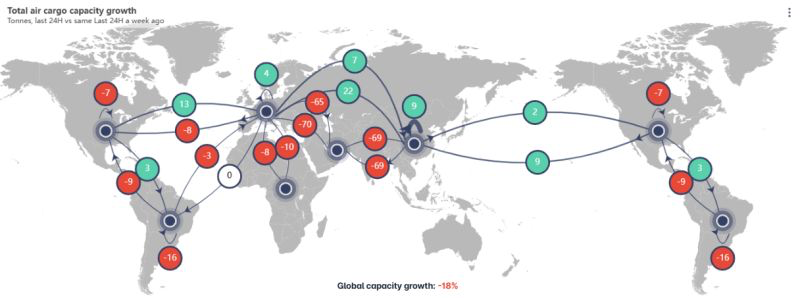
According to Rotate’s Live Capacity data, approximately 13 percent of global air cargo lift is directly affected by the restrictions. Within just 24 hours of the first major flight suspensions, total global capacity fell by 18 percent compared with the same period the previous week — a significant shock to an industry already navigating geopolitical volatility and fragile trade flows.

The disruption follows escalating tensions linked to US and Israeli strikes on Iran, which have resulted in widespread airspace closures and airport shutdowns across parts of the region.

Related Post
Worldwide tonnages up +6% in April, year on year – WorldACD Weekly Air Cargo Trends (week 17)

WorldACD Weekly Air Cargo Trends (week 1)

Seahorse freight association launches mentoring program and rewards excellence in Journalism

Amazon Air’s Third-Party Service Offering Poised for Growth, Analysis Finds

Gulf Carriers Grounded

At the centre of the capacity contraction is the temporary suspension of services by leading Gulf carriers, including Qatar Airways, Emirates and Etihad Airways. Collectively, these airlines represent a substantial share of long-haul bellyhold and freighter capacity connecting Asia, Europe and Africa.

Tim van Leeuwen, Vice President and Head of Consulting at Rotate, said the figures underscore the structural importance of Middle Eastern hubs within global supply chains.

“As the scale and impact of the US/Israel strikes on Iran becomes more clear, it is already evident that Middle East airspace closures will have a significant effect on the air cargo industry, with Rotate Live Capacity data showing 13 percent of global air cargo capacity directly affected,” he noted.

Van Leeuwen highlighted the magnitude of the interruption. Prior to the suspensions, Qatar Airways was operating approximately 12,000 tonnes of daily cargo capacity, while Emirates accounted for around 10,000 tonnes per day. The temporary withdrawal of this lift has immediate consequences for time-sensitive supply chains and intercontinental trade lanes.

Having initially reported that around 12 percent of global capacity would be impacted, Rotate’s updated figures now show an 18 percent global decline within a 24-hour window compared with last week.

Three Drivers Behind the Capacity Drop

Rotate identifies three principal factors behind the sudden contraction:

  • Middle Eastern carriers suspending operations, at least temporarily
  • Non-regional airlines halting services to Gulf destinations without short-term alternatives
  • Freighter aircraft rerouting to alternative technical stops or operating longer direct sectors, affecting payload and network balance

The Middle East’s role as a strategic bridge between East and West means that even partial closures reverberate across multiple trade corridors. Asia–Europe flows, in particular, are facing structural adjustments as airlines redesign routings to bypass restricted airspace.

Counterintuitive Shifts in Asia–Europe Flows

Interestingly, Rotate’s data reveals that Asia–Europe capacity increased by 22 percent during the same period. This rise is attributed to carriers switching technical stops to Central Asian airports or operating direct long-haul sectors rather than routing via Gulf hubs.

However, analysts caution that this increase does not offset the broader systemic disruption. Longer routings can reduce payload due to weight restrictions, increase fuel burn, and disrupt finely balanced hub-and-spoke networks. Moreover, the temporary capacity boost on specific corridors may prove unsustainable if airspace restrictions persist.

Network Reshaping Underway

The suspension of Gulf carrier operations is not merely a short-term scheduling issue; it is reshaping global airfreight networks in real time. The Middle East has long functioned as a central transhipment crossroads for intercontinental cargo. With that bridge partially removed, airlines are being forced to adopt more fragmented, point-to-point solutions.

The coming days will determine whether capacity stabilises through alternative routings or whether prolonged closures lead to sustained rate volatility and supply chain bottlenecks.

For now, the data confirms what many forwarders and shippers are already experiencing: a rapid and significant tightening of global air cargo lift capacity driven by geopolitical escalation in one of aviation’s most strategically vital regions.

Tags: air cargo capacity down 18 percentairfreight rerouting via Central AsiaAsia–Europe air freight disruptionaviation data analysis RotateEmirates freighter operationsEtihad Airwayscargo networkgeopolitical impact on air cargoglobal air cargo capacity declineglobal cargo network reshapingGulf carriers flight suspensionintercontinental bellyhold capacity lossMiddle East airspace closuresQatar Airways cargo capacityRotate Live Capacity data
ShareTweetPin
Devender Grover

Devender Grover

Devender was born in the year when the Beatles Group was formed. He holds two master’s degrees in English Literature and Public Administration. He also has an Honors degree in English Literature and a post-graduate diploma in Corporate Communications and Public Relations. He was closely associated with the Indian State Transport Undertakings and Ministry of Transport in his role as Corporate Communications and PR specialist for over two decades handling domestic and international organizations. He ventured into business forming his own Media House, Profiles Media Network Private Limited which is now a twenty years old company. Excelling as an editor, Marketing, PR, Anchor, and Advertising specialist, he is now expertly navigating the world of social media. A widely traveled professional internationally, Devender has a deep understanding of the Air Cargo, Cargo Business, Cargo Airports, Freighters and Cargo Industry at large.

cargo.one acquires ocean platform Cargofive, launches AI-native operating system for multimodal logistics

March 2, 2026

Middle East Aviation Remains Grounded as Airspace and Airports Close Across the Region

Middle East Airspace Closures Slash Global Air Cargo Capacity by 18%, Says Rotate

IAG Cargo delivers 2025 revenues of €1,238 million

Kale Logistics Marks 15th Anniversary with Launch of AvSys, a Cross-Border E-Commerce Visibility Platform

ECS Group Honoured as International GSSA of the Year at STAT Trade Times 2026

Tags

Airbus Air Cargo Aircargo Air Cargo News Air Freight Airfreight Airlines Air Logistics Atlas Air Aviation Aviation Industry AviationIndustry AviationLogistics Aviation News AviationNews Boeing cargo industry news Cargo International News cargo operations Covid 19 DHL dnata E-commerce Emirates SkyCargo Etihad Cargo Europe Freighter Freight Forwarding Global Logistics global trade IAG Cargo IATA Logistics LogisticsInnovation Logistics News Lufthansa Cargo Qatar Airways Qatar Airways Cargo Supply chain Sustainability Swissport Technology TIACA Turkish Cargo WFS
  • Home
  • About us
  • Magazine
  • Subscribe
  • Reels
  • Events
  • Advertise
  • Careers
  • Contact us
  • Terms & Conditions
  • Privacy Policy
  • Cookie Policy

Copyright © 2025 Profiles Media Network Pvt Ltd. All Rights Reserved.

Welcome Back!

Login to your account below

Forgotten Password?

Retrieve your password

Please enter your username or email address to reset your password.

Log In
No Result
View All Result
  • Home
  • News
    • Airlines
    • Airports
    • Associations
    • Business
    • Freight Forwarders
    • People
    • Cargo Handling
    • Sectors
    • Services
    • Technology
    • News By Date
  • Reels
  • Magazine
  • Archive News
  • Subscribe
  • Newsletter
  • Advertise
  • Jobs
  • Events

Copyright © [2024] Profiles Media Network Pvt Ltd All Rights Reserved. Build with ❤️ by Onairdigital

Our website uses cookies. We use cookies and similar technologies to personalise content, to provide you with relevant marketing, to enhance your user experience and to gain insight and track how you interact with us and our partners. Learn more in our Privacy Policy and Cookie Policy.