Global air cargo markets experienced renewed pressure during the second week of July, with worldwide volumes and freight rates trending lower as geopolitical uncertainty, regulatory changes and weather disruptions affected key trade lanes.
According to the latest weekly market analysis from WorldACD Market Data, global air cargo tonnages declined by 4% week-on-week (WoW) during week 28 (6–12 July 2026). The decline was largely driven by weaker volumes from the Asia Pacific region, where tonnage fell by 7% WoW, impacted by disruptions caused by Typhoon Bavi, which affected capacity and chargeable weight, particularly from Taiwan and parts of East Asia.
The market also continued to adjust to changes in European import regulations and heightened uncertainty linked to renewed tensions involving the US and Iran.
Related Post

Asia Pacific Cargo Flows Under Pressure
Asia Pacific remained the key area of weakness, with several major export markets recording declines.
Air cargo volumes from Asia Pacific to Europe fell by 10% WoW in week 28 and were 15% lower compared with the same period last year, reflecting softer demand and regulatory changes affecting inbound European trade.
Taiwan recorded the largest percentage decline on the Europe route, with volumes falling 24% WoW. However, China represented the largest reduction in actual tonnage, with shipments to Europe declining 13% WoW and 15% year-on-year (YoY).
Hong Kong also continued to experience weaker performance, with volumes down 23% YoY, following four consecutive weeks of declining weekly volumes. Market observers linked part of the decline to the European Union’s removal of de minimis import tariff exemptions from July 1, which has affected certain e-commerce cargo flows.
On the transpacific trade lane, Asia Pacific volumes to the US declined by 5% WoW, although volumes remained 11% higher YoY. Taiwan and Hong Kong were notable exceptions, recording year-on-year declines.
Middle East and South Asia Impacted by Geopolitical Risks
Air cargo activity from the Middle East and South Asia (MESA) region also weakened during the period.
Chargeable weight from MESA origins declined 4% WoW, while regional capacity dropped 3% WoW. The impact was particularly visible on routes to the United States, where volumes fell by approximately 14% WoW as carriers and shippers adjusted to the effects of escalating US-Iran tensions.
Despite these challenges, cargo volumes from MESA to Europe showed some resilience, increasing 4% WoW and remaining broadly comparable with levels recorded during the same week last year.
Freight Rates Continue Downward Trend
Air cargo pricing continued its downward movement in week 28, marking the third consecutive weekly decline.
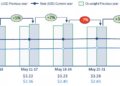
Global average airfreight rates, combining contract and spot pricing, fell 3% WoW to US$3.03 per kilogram. Despite the decline, rates remained 24% higher YoY, indicating that pricing continues to sit above last year’s levels.
Global spot rates also declined 3% WoW to US$3.47 per kilogram, although they remained 32% higher YoY.
The largest weekly spot rate reductions were recorded from:
- Africa: down 8%
- Middle East & South Asia: down 4%
- Europe: down 4%
- Asia Pacific: down 2%
North America was the only major origin region to record an increase, with spot rates rising 3% WoW, supported by post-Independence Day market activity in the United States.
China-Europe Lane Shows Significant Weakness
The China-Europe air cargo market was among the most affected during the week.
Average spot rates from Asia Pacific to Europe declined for the third consecutive week, falling 5% WoW to US$4.82 per kilogram. China-origin shipments experienced the sharpest deterioration, with spot rates falling 9% WoW to US$4.45 per kilogram.
While Asia Pacific-Europe spot rates remained 25% higher YoY, China-Europe spot rates increased only 15% YoY, representing the smallest annual growth rate since March.
The latest market data indicates that both China-Europe and broader Asia Pacific-Europe spot rates have returned to levels last seen in late March, reflecting softer demand conditions and changing trade patterns.
Outlook: Market Balancing After Strong First Half
The latest trends suggest that global air cargo markets are entering a period of adjustment following stronger growth earlier in the year. While rates remain significantly above 2025 levels, declining volumes on major trade lanes and easing spot prices indicate a gradual balancing between supply, demand and capacity availability.
Weather disruptions, geopolitical developments and evolving trade regulations are expected to remain key factors influencing air cargo performance through the remainder of the summer season.