

Air cargo demand between Hong Kong and Europe has fallen sharply in recent weeks as new European Union customs rules begin to affect cross-border e-commerce shipments.
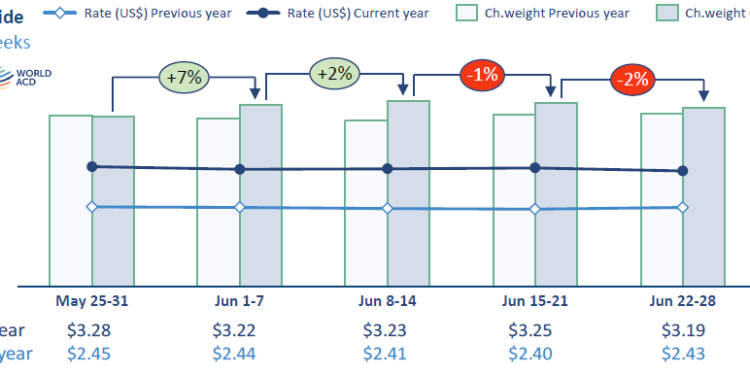
According to the latest data from WorldACD, cargo volumes from Hong Kong to Europe dropped 12% week-on-week during the week ending 5 July. That followed earlier weekly declines of 7% and 2%, showing demand has been slowing for several weeks.
WorldACD said the drop was linked to the end of the EU’s duty-free exemption for low-value imports and the introduction of new customs charges on e-commerce parcels. The latest figures have pushed Hong Kong-Europe cargo volumes back to levels last seen at the end of March.
Related Post




China-Europe traffic appears to be stabilising after a 6% decline in the previous week. Across the wider Asia-Pacific region, cargo volumes to Europe fell 2% during the same week, following a 4% drop a week earlier.
Airlines have already started adjusting to weaker demand.
Data from Rotate shows direct freighter capacity fell by around 19% in early July compared with the previous week, with Hong Kong seeing the biggest reduction in available cargo space.
The EU’s new customs rules apply to low-value parcels imported from outside the bloc, including many products sold through online shopping platforms. Items such as clothing, electronics, toys and other consumer goods are now subject to the new customs charge under the updated rules.
Not every market is seeing weaker demand, though.
Taiwan-Europe air cargo has been moving in the opposite direction. WorldACD data shows volumes have climbed by around 20% over the past three weeks, driven largely by shipments of AI-related computer equipment.
During the same period, Taiwan-US cargo volumes slipped about 5%, while Hong Kong-US traffic fell roughly 7%. In comparison, Hong Kong-Europe volumes dropped by around 20%, making Europe the weakest-performing market.
Overall, global air cargo volumes declined 2% during the week ending 5 July. Along with softer Hong Kong-Europe demand, the slowdown was also influenced by reduced shipping activity around the US Independence Day holiday on 4 July.