
- Emirates Group has today announced its half-year results, and has recorded a profit before tax of US$ 1.1 billion amid the ongoing storm of regional conflict in the Middle East and soaring fuel costs.
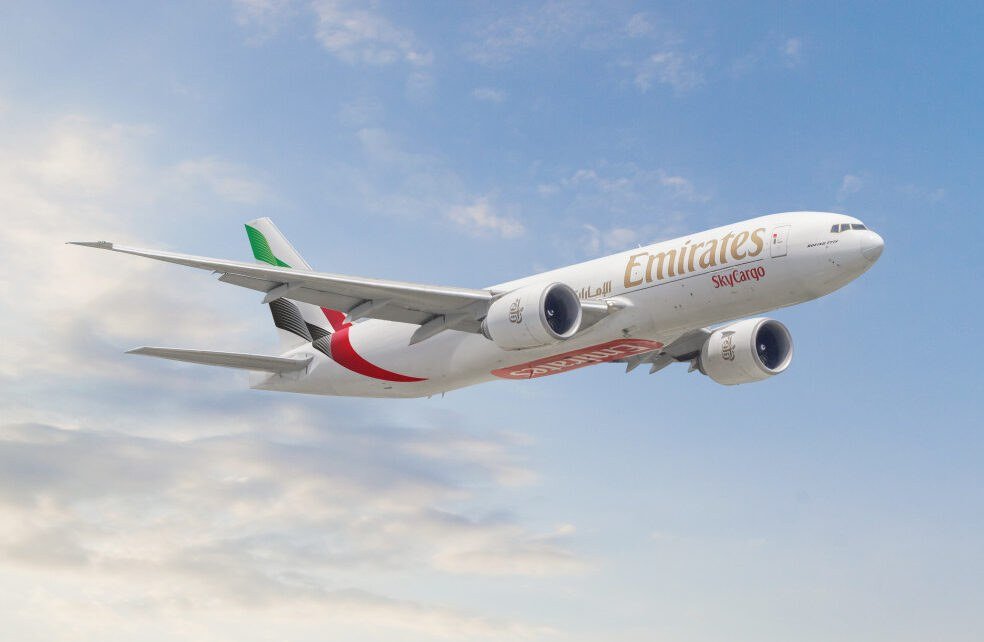
- According to the Group, this was due to ‘resilient demand’ and ‘strong cargo performance,’ as Emirates SkyCargo saw its revenues increase by 52 percent.
- The Group has stated this is ‘a remarkable performance against the disruption and high fuel prices caused by the ongoing conflict in the Gulf region.’
Emirates SkyCargo increased revenue by 52% in the first half of the 2026-27 financial year, despite a 1% decline in cargo volumes to 1.2 million tonnes. The airline attributed the growth to reduced air freight capacity amid conflict-related disruption in the Gulf and interruptions to maritime transport, which encouraged shippers to seek alternative air cargo solutions.
Emirates SkyCargo delivered a strong revenue performance during the six months ended 30 September 2026, helping support the wider Emirates Group as regional conflict, airspace restrictions and sharply higher fuel prices weighed on aviation operations.
The cargo division transported 1.2 million tonnes, marginally below the volume recorded in the same period a year earlier. However, cargo revenue rose by 52%, reflecting a market in which available air freight capacity was reduced while disruption to maritime supply chains increased demand for air transport.
Related Post


The results highlight the growing importance of cargo to airline resilience during periods of geopolitical and logistics disruption. While freight tonnage remained broadly stable, the sharp revenue increase points to a substantially stronger commercial environment for air cargo during the reporting period.
Freighter fleet and network expansion
Emirates SkyCargo continued to expand its fleet and international reach during the first half of 2026-27. It added capacity through the delivery of five new Boeing 777 freighters and the deployment of its first passenger-to-freighter (P2F) converted aircraft.
The carrier also added two destinations to its dedicated freighter network: Almaty in Kazakhstan and Zhengzhou in China. Dedicated freighter services were introduced to more than 15 destinations already served by Emirates’ passenger network, while frequencies increased across several key markets, particularly in the Far East.
The expansion strengthens the airline’s ability to serve a wider range of cargo markets and respond to changing customer requirements. The combination of new-build freighters, converted aircraft and additional network frequencies also provides greater flexibility as international trade flows and transport options evolve.
Group results reflect pressure across aviation operations
At Group level, Emirates reported a profit before tax of AED 4.1 billion (US$1.1 billion) for the first half, down 66% year on year. Revenue declined 12% to AED 66.2 billion (US$18 billion), while Group EBITDA fell 41% to AED 12.5 billion (US$3.4 billion).
The Group closed the six-month period with cash reserves of AED 54.1 billion (US$14.7 billion) as at 30 September 2026. Chairman and Chief Executive Sheikh Ahmed bin Saeed Al Maktoum said resilient customer demand and the contribution from cargo operations had helped sustain revenue and cash levels despite the challenging environment.
He also said the Group had continued investing in fleet expansion, products, services and future capabilities, and remained focused on managing costs and geopolitical uncertainty during the second half of the financial year.
dnata advances global cargo investment programme
The results also highlighted dnata’s continued investment in its international cargo and logistics network. The ground services and travel group reported revenue of AED 11 billion (US$3 billion), down 7%, and profit before tax of AED 410 million (US$112 million), a 51% decline.
dnata handled 1.49 million tonnes of cargo, down 6% compared with the same period last year. Its airport operations generated AED 5.4 billion in revenue, with growth in international markets helping offset lower airline activity at its UAE hub.
The company continued to develop its cargo infrastructure during the period. It commissioned a new AED 100 million (US$27 million) logistics facility in Dubai South and announced an AU$32 million investment in a cargo facility at Western Sydney International Airport. It is also progressing a planned AED 37 million investment in Alat, Azerbaijan, alongside new and expanded cargo operations at East Midlands Airport in the UK and Zurich Airport in Switzerland.
In Dubai, dnata opened an integrated command centre to support its growing cargo operations. It also secured new business, including a cargo partnership with Silk Way Group in Singapore. These developments form part of its strategy to expand cargo handling, logistics and technology capabilities across its international network.
The half-year performance presents a mixed picture for the Emirates Group. While regional disruption and fuel inflation weighed heavily on overall profitability, the sharp rise in Emirates SkyCargo revenue demonstrates the importance of air freight in maintaining commercial momentum during periods of wider supply chain uncertainty. Continued investment in freighter capacity, network reach and cargo infrastructure will be central to the Group’s ability to capture demand as market conditions evolve.