
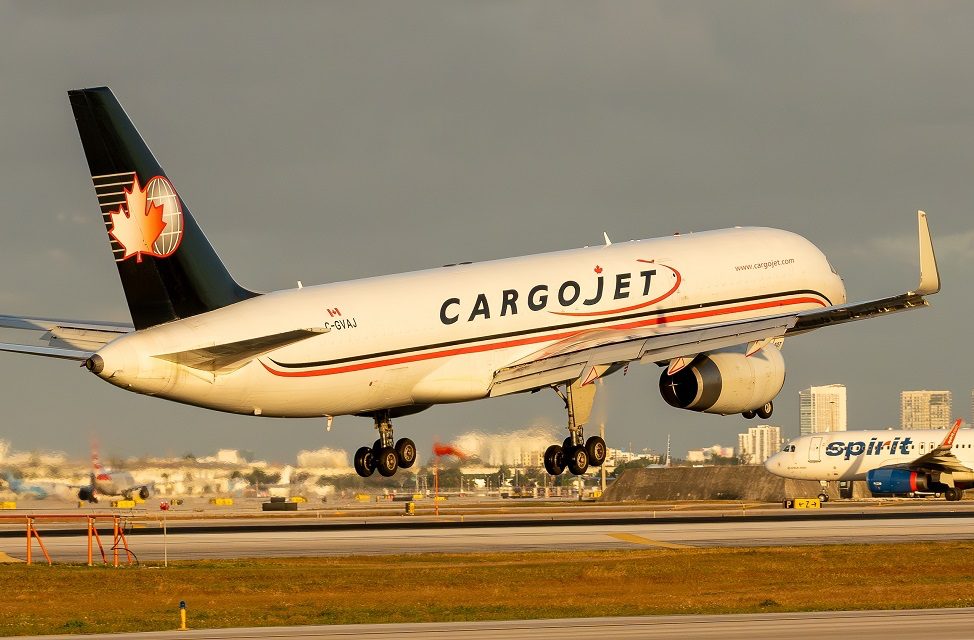
Cargojet reported stronger financial performance in the second quarter of 2026, with revenue and adjusted EBITDA increasing year on year as higher fuel costs, contractual price adjustments and additional charter activity supported the Canadian freighter operator’s results. The company has also secured a new five-year collective agreement with its pilots following an arbitration process.
Cargojet reported second-quarter revenue of C$275.8 million, an increase of 15.8% from the same period a year earlier. Adjusted EBITDA rose 8.9% to C$87.3 million, while net earnings reached C$7 million, compared with a net loss of C$3.2 million in the second quarter of 2025.
The results reflect a combination of pricing mechanisms within Cargojet’s customer contracts, higher fuel-related revenue and growth in its charter business, as the company continues to manage capacity across its domestic, ACMI and international operations.
Related Post


Cargojet had previously indicated that it would release its second-quarter results on August 10, with CEO Pauline Dhillon, CFO Aaron McKay and VP of Finance Sanjeev Maini scheduled to discuss the results with investors the following day. The company’s official news page now lists the Q2 2026 financial results release.
Charter business provides key contribution
Cargojet’s all-in charter operation was the strongest contributor among its major business segments during the quarter.
Charter revenue increased 37.4% year on year to C$57.4 million, with the company attributing the improvement primarily to new charter opportunities. This growth was partly offset by lower year-on-year frequency on scheduled charter services between China and Canada.
The development highlights the flexibility of Cargojet’s charter operation, which allows the company to deploy aircraft according to customer requirements and changing international freight flows.
Cargojet has been adjusting its international network in response to changes in demand and available opportunities. The company said that aircraft redeployment from long-haul services connecting Asia and Europe to selected South American routes was one of the factors behind a decline in ACMI revenue during the quarter.
The company also supported a customer that had previously operated MD-11 freighters. Those aircraft were temporarily grounded following the fatal UPS Airlines accident last year, creating additional demand for alternative capacity.
Domestic network remains resilient
Cargojet’s domestic network continued to provide a stable revenue base during the quarter.
Domestic network revenue increased 8.1% to C$110.6 million, supported by contractual consumer price index adjustments and higher fuel-related charges.
Fuel remained an important factor in the company’s reported revenue performance. Cargojet recorded a 45.9% year-on-year increase in fuel costs during the quarter.
The company’s customer contracts include mechanisms that allow fuel-related costs to be passed through to customers through fuel surcharges, although such adjustments typically occur with a time lag.
This structure means that movements in fuel prices can influence both Cargojet’s operating costs and reported revenue, without necessarily representing an equivalent improvement in underlying margins.
The distinction is important when assessing the quarter’s headline revenue growth, particularly in a market where jet fuel prices remain a significant cost consideration for freighter operators.
ACMI revenue declines as aircraft are redeployed
While domestic and charter operations recorded growth, Cargojet’s ACMI business moved in the opposite direction.
ACMI revenue declined 12.6% year on year to C$54.6 million. The company attributed the decrease primarily to the redeployment of aircraft previously operating longer-distance routes in Asia and Europe to selected routes in South America.
ACMI, or aircraft, crew, maintenance and insurance services, provides customers with cargo aircraft capacity and operational support without requiring them to operate the aircraft themselves.
For Cargojet, the segment provides an additional channel through which aircraft can be deployed internationally. The latest results indicate how changes in regional demand can influence the mix of services within the company’s broader network.
The company has also been pursuing opportunities in international markets while maintaining its established domestic operation. In April, Cargojet announced that it was divesting its minority investment in Miami-based 21 Air, saying the move would allow it to focus capital and management attention on its domestic network, ACMI and charter operations. Cargojet and 21 Air said they would continue to collaborate on selected commercial opportunities.
New international opportunities
Cargojet’s international network has continued to evolve alongside its charter and ACMI activities.
The company has also added a service linking Liège and Tel Aviv, building on its European operations and providing another connection between Europe and the Middle East.
Cargojet’s international development comes as air cargo markets continue to adjust to changing trade flows, geopolitical conditions and variations in regional capacity.
The carrier operates dedicated freighter services alongside ACMI and international charter operations, giving it the ability to combine scheduled network activity with more flexible capacity deployments.
Cargojet says it transports more than 25 million pounds of cargo each week and operates a fleet of 41 aircraft. Its network covers major Canadian cities as well as international destinations through its dedicated, ACMI and charter services.
Operational performance remains a focus
Alongside financial performance, Cargojet continues to emphasise operational reliability.
The company has highlighted its ability to maintain high on-time performance while managing changing demand across its network. In its first-quarter 2026 results, Cargojet reported an on-time performance of 99.2%, while describing domestic revenue as resilient despite wider market and geopolitical pressures.
That operational consistency remains particularly important for time-sensitive cargo, where reliability is a central component of customer service and network planning.
Cargojet’s business model also relies heavily on long-term customer relationships, providing a degree of stability across its domestic and international operations even when individual markets experience fluctuations.
Five-year pilot agreement takes effect
The second-quarter financial results come shortly after Cargojet concluded its long-running collective bargaining process with its pilots.
On July 27, Cargojet announced that it had received the final award of arbitrator William Kaplan establishing the terms of a new collective agreement with the Air Line Pilots Association (ALPA).
The agreement is effective from July 1, 2026 through June 30, 2031. Cargojet said the award followed extensive negotiations and mediated discussions that began in late 2025.
The five-year agreement addresses compensation and operating provisions and, according to Cargojet, brings the terms more closely into line with current industry standards.
The company said the agreement provides greater continuity for customers, employees and shareholders while supporting productivity, operational performance and long-term sustainability.
The agreement also removes an important area of uncertainty for the carrier as it plans its fleet and network requirements over the coming years.
Cargojet CEO Pauline Dhillon said the conclusion of the process would allow the company to focus on working with its pilots and maintaining the service levels expected by customers.
Looking ahead
Cargojet enters the second half of 2026 with a business increasingly shaped by the balance between domestic network stability and international opportunities.
The second-quarter figures show continued growth in charter and domestic operations, while ACMI performance reflects the company’s willingness to redeploy aircraft towards markets where it sees available opportunities.
The combination of dedicated domestic services, ACMI capacity and international charter operations gives Cargojet several channels through which to respond to changing cargo demand.
At the same time, the new five-year pilot agreement provides a longer-term framework for the company’s flight operations and workforce planning.
Cargojet has also continued to focus on operational standards. On August 12, the company announced that it had retained its ISO 9001:2015 Quality Standard Accreditation for the 24th consecutive year, describing the certification as part of its wider focus on quality, reliability and continuous improvement.
Taken together, the developments point to a carrier balancing network flexibility with long-term operational planning as it navigates changing international freight demand, fuel costs and evolving customer requirements.