
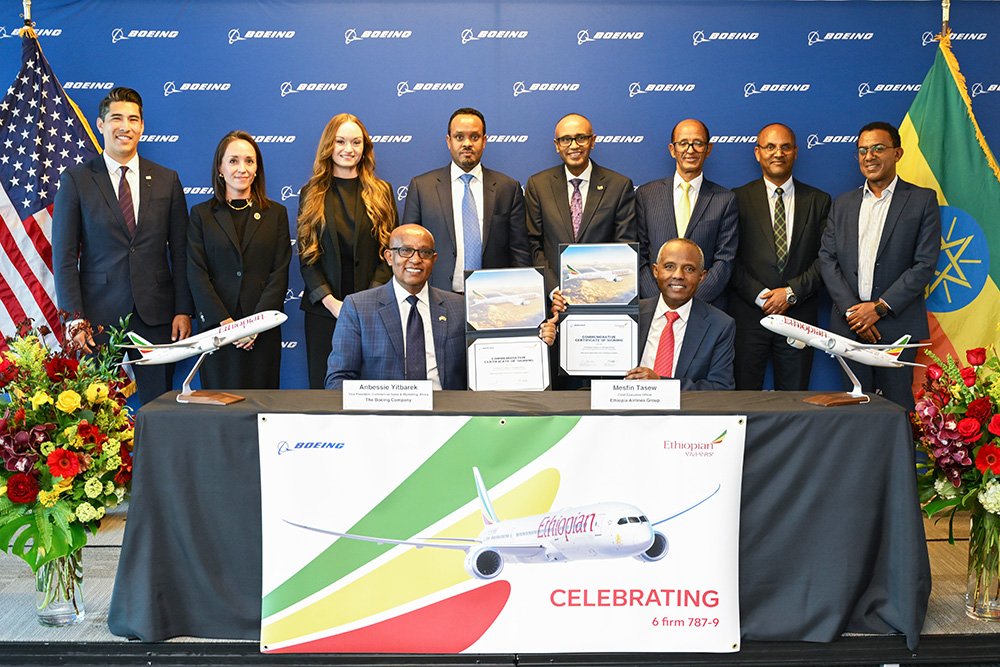
Ethiopian Airlines has converted options for six Boeing 787-9 Dreamliner aircraft into firm orders, reinforcing its long-term fleet expansion strategy and enhancing both passenger and cargo capacity across its intercontinental network.
The agreement with Boeing builds on the airline’s 2023 order commitment and underscores Ethiopian Airlines’ continued investment in modern, fuel-efficient widebody aircraft. The additional 787-9 jets are expected to support the carrier’s expansion from its hub in Addis Ababa, enabling increased connectivity across key long-haul markets.
Supporting Network Expansion and Cargo Demand
Ethiopian Airlines, currently the largest operator of the 787 Dreamliner family in Africa, deploys both 787-8 and 787-9 variants across high-demand routes linking Africa with Europe, Asia, and North America. The addition of six new aircraft will allow the airline to further scale its long-haul operations while strengthening its role as a major aviation gateway on the continent.
Related Post



In addition to passenger growth, the new aircraft will provide increased bellyhold cargo capacity, a critical factor as global air freight demand continues to evolve. Widebody passenger aircraft such as the 787 play a key role in transporting time-sensitive and high-value goods on major trade lanes, complementing dedicated freighter operations.
Efficiency and Operational Flexibility
The Boeing 787-9 Dreamliner is designed for long-range efficiency, offering reduced fuel consumption and lower emissions compared to previous-generation aircraft. Its operational flexibility enables airlines to open new point-to-point routes while maintaining cost efficiency, an important consideration for carriers expanding across geographically diverse markets such as Africa.
For Ethiopian Airlines, the aircraft type forms a central component of its fleet strategy, supporting both network diversification and operational resilience. The airline continues to leverage modern aircraft technology to enhance service quality while maintaining competitive operating costs.
Strategic Growth for Africa’s Leading Carrier
Ethiopian Airlines Group remains one of the fastest-growing aviation groups globally, serving more than 145 international destinations with a fleet of over 170 aircraft. The airline has played a key role in strengthening intra-African connectivity while linking the continent to major global markets.
As a member of the Star Alliance, Ethiopian Airlines continues to expand its global reach through strategic partnerships and network development. Its consistent investment in fleet modernisation reflects a broader ambition to maintain its leadership position in Africa’s aviation sector.
Cargo Implications
From a cargo perspective, the fleet expansion is expected to enhance capacity on key intercontinental corridors, particularly those connecting Africa with major manufacturing and consumer markets. The additional belly capacity provided by the 787-9 aircraft will support growing demand for e-commerce, pharmaceuticals, perishables, and industrial goods.
Industry analysts note that African carriers are increasingly leveraging widebody passenger fleets to complement dedicated freighter operations, creating more flexible and resilient cargo networks in response to fluctuating global demand.
Outlook
The firming of these aircraft orders highlights Ethiopian Airlines’ confidence in long-term growth prospects for both passenger travel and air cargo. As global supply chains continue to adapt and diversify, the airline’s expanding widebody fleet is expected to play a crucial role in supporting Africa’s integration into global trade flows.