
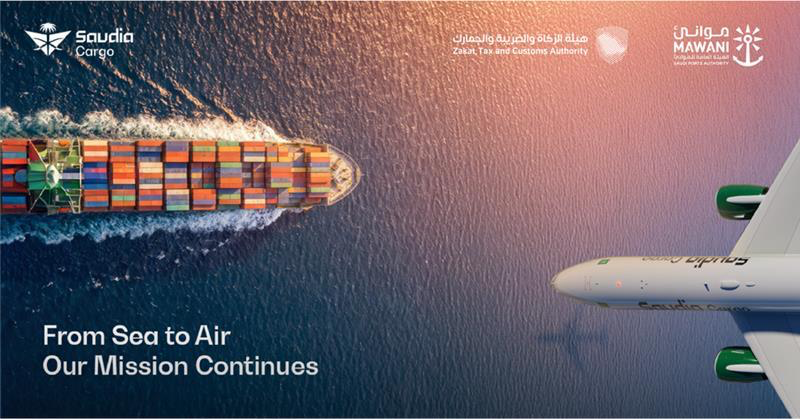
Saudia Cargo has unveiled an expanded strategic collaboration with the Saudi Ports Authority (Mawani) and the Zakat, Tax and Customs Authority (ZATCA) to establish a pioneering sea‑to‑air logistics corridor that enhances cargo mobility through Saudi Arabia’s western seaboard and into global markets. The initiative was announced as part of broader logistics innovation discussions at the International Air Transport Association (IATA) World Cargo Symposium (WCS) currently underway in Lima, Peru.
The new corridor links major maritime gateways, starting with Jeddah Islamic Port, with key airfreight hubs, enabling inbound ocean freight to seamlessly transition into expedited air transport. The initiative responds to shifting shipping patterns, regional transport dynamics and ongoing uncertainties affecting maritime routes, providing businesses with reliable alternatives to maintain supply chain continuity.
Integrated Multimodal Framework
At the heart of the initiative is a commitment to integrate seaports and airports as complementary logistics gateways within Saudi Arabia’s rapidly growing transport ecosystem. By facilitating efficient modal transfers, the corridor aims to reduce overall transit times, balance cost‑efficiency with speed of delivery and strengthen the Kingdom’s position as a central logistics bridge between continents. Mawani’s ports—responsible for handling more than 8 million TEUs of containerised cargo in 2025—are pivotal to this vision as they expand throughput and multimodal connectivity under the National Transport and Logistics Strategy.
Under the new framework, ZATCA plays a critical enabling role by harmonising customs procedures across maritime and aviation entry points. A single customs declaration system, supported by advanced pre‑clearance and smart inspection controls, allows containers to move swiftly from port berths to airport runways with reduced dwell times. This bonded transit regime not only accelerates cargo movement but also reinforces the Kingdom’s regulatory efficiency in a global logistics context.
Strategic Imperatives and Operational Benefits
For Saudia Cargo, the sea‑to‑air corridor adds a strategic layer to its network offering, providing shippers with new pathways to route goods when maritime shipping patterns fluctuate or routes are disrupted. By pivoting seamlessly between sea and air, the initiative enhances resilience in supply chains, particularly for time‑sensitive and value‑added cargo sectors.
The corridor’s activation at Jeddah Islamic Port underscores the importance of the Red Sea gateway within regional supply chain realignment, especially as wider logistics networks in the Gulf adapt to alternative trade lanes and multimodal freight solutions.
Officials from Saudia Cargo, Mawani and ZATCA reaffirmed their commitment to ensuring that essential and commercial goods continue to move reliably, irrespective of external pressures on marine or air routes. By strengthening sea‑to‑air connectivity, activating alternative logistics paths, and enabling dependable links across the Kingdom’s key entry points, the collaboration aims to protect trade flows and maintain continuity across critical supply chains.