
Global air cargo markets have experienced a marked slowdown in early 2026, as geopolitical instability in the Middle East disrupted previously strong growth momentum, according to data released by WorldACD Market Data.
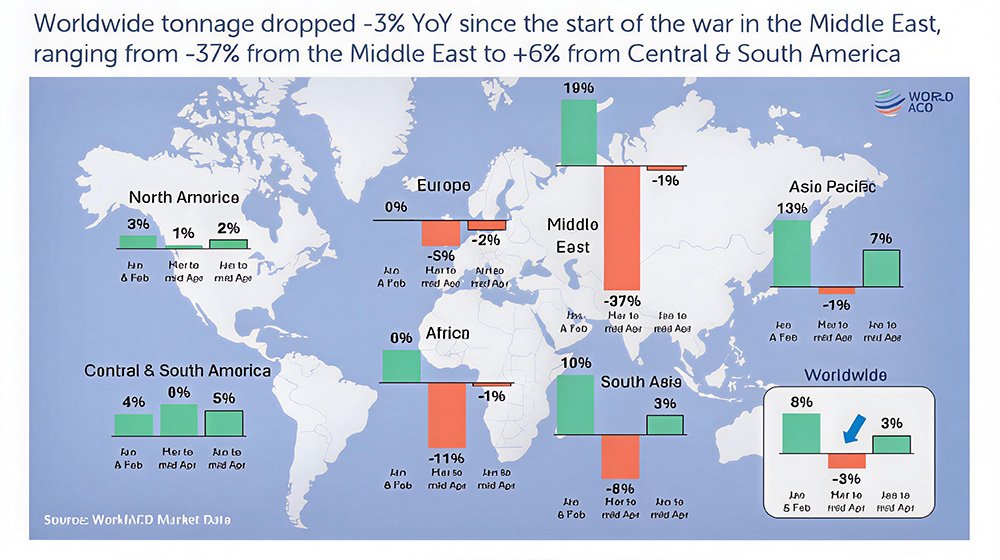
Analysis based on year-on-year changes in chargeable weight reveals a clear inflection point in global demand patterns. Air cargo volumes grew by 8 percent during January and February, reflecting a robust start to the year. However, following the onset of the Middle East conflict in March, global tonnage declined by 3 percent through mid-April. This shift resulted in a modest overall growth rate of 3 percent for the year-to-date period.
The Middle East emerged as the epicentre of this reversal. The region recorded a sharp swing from a 19 percent increase in the first two months of 2026 to a steep 37 percent decline in the weeks following the outbreak of hostilities. The data underscores the sensitivity of air cargo flows to geopolitical disruptions, particularly in strategically critical transit hubs.
Beyond the Middle East, several other regions also registered declines during the same period. South Asia saw volumes fall by 8 percent, while Africa experienced an 11 percent contraction. Europe reported a comparatively moderate decrease, reflecting more stable intra-regional demand.
In the Asia-Pacific region, growth momentum also weakened. After posting a 13 percent increase in January and February, volumes edged down by 1 percent from March to mid-April. Within this region, China recorded a more pronounced 7 percent decline, signalling softening export demand and shifting trade dynamics.
In contrast, the Americas stood out as relative bright spots. Both Central and South America, along with North America, continued to post growth during the March-to-mid-April period, defying the broader global downturn and highlighting regional resilience amid external shocks.
WorldACD’s comparative dataset—tracking January–February performance against the period from March to mid-April, as well as year-to-date figures—illustrates a decisive shift in global air cargo trends. Most regions transitioned from positive growth to contraction following the escalation of conflict, with the Middle East exhibiting the most dramatic reversal.
The findings reinforce the interconnected nature of global logistics networks, where regional disruptions can quickly cascade across supply chains. As airlines, freight forwarders, and shippers navigate ongoing uncertainty, market stability will likely depend on geopolitical developments and the ability of alternative trade lanes to absorb displaced capacity.