
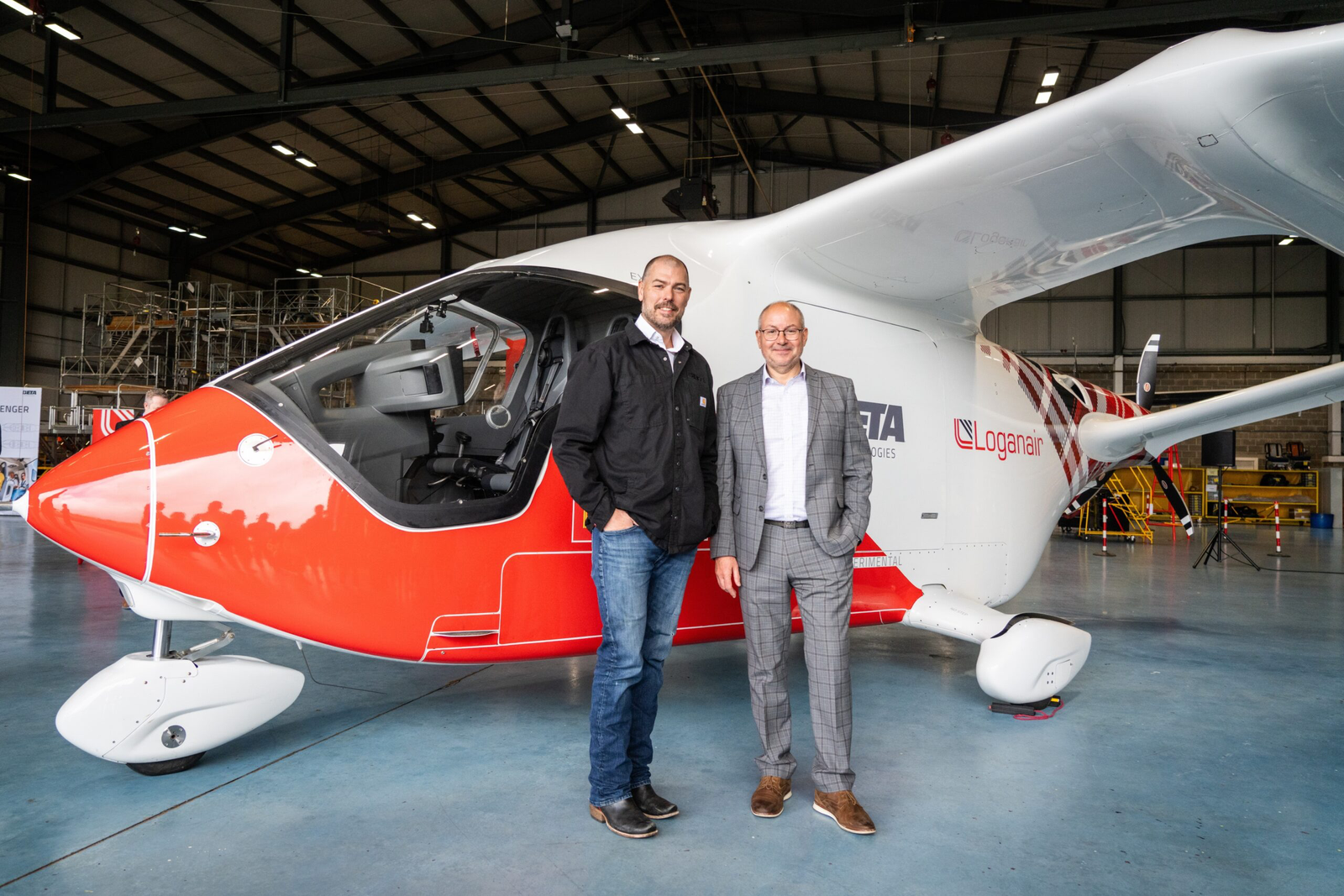
Loganair, Royal Mail, and U.S.-based electric aviation innovator BETA Technologies have successfully completed the United Kingdom’s first electric flight demonstration program, showcasing the operational potential of zero-emission aircraft across Scotland’s regional network.
Over a 10-day period, BETA’s ALIA CTOL (Conventional Takeoff and Landing) electric aircraft completed 23 flights, including 18 legs connecting key Scottish airports such as Glasgow, Dundee, Aberdeen, Inverness, Wick, and Kirkwall. The aircraft logged 1,006 nautical miles in 11.2 flight hours, conducting representative Royal Mail postal routes to deliver critical services to some of Scotland’s most remote communities. Missions averaged 56 nautical miles at speeds of 99 knots with energy efficiency measured at 1.37 kWh per nautical mile.
Strategic Importance for Regional Connectivity
Scotland’s geography, with over 90 inhabited islands and communities separated by challenging terrain, positions the region as a natural testbed for electric aviation. Short-haul routes of under 100 miles align closely with the current operational range of electric aircraft, highlighting a clear path for early commercial deployment.
Related Post

The program validated aircraft performance, ground handling procedures, charging operations, and integration with existing airspace and airport systems. Collaboration with AGS Airports and Highlands and Islands Airports Limited (HIAL) enabled the deployment of BETA’s compact, mobile mini-cube charging solution, demonstrating that electric operations can be supported using existing infrastructure with minimal upgrades.
Collaboration with Key Stakeholders
Royal Mail, responsible for delivering to 32 million addresses across the UK daily, including the most remote locations, participated in the demonstration to explore decarbonising essential flight routes. Loganair, with six decades of experience in regional connectivity, contributed operational expertise and route knowledge to ensure successful integration.
Kyle Clark, founder and CEO of BETA Technologies, said:
“These flights prove that electric aviation can support the essential services communities depend on every day. ALIA is designed for exactly these missions, connecting people and moving goods with lower operating costs and zero emissions. This collaboration represents a meaningful step toward commercial electric operations in Scotland and beyond.”
Luke Farajallah, CEO of Loganair, added:
“This is a historic milestone for UK aviation. The MoU signed with BETA Technologies allows us to build on the data collected and evaluate how electric aircraft could operate across our entire network. The results are encouraging for the future of sustainable regional aviation.”
Chris Paxton, Strategic Insight and Innovation Manager at Royal Mail, commented:
“Delivering to every UK address requires dependable connectivity. The success of this trial demonstrates the potential for decarbonising Scottish flight routes as part of Royal Mail’s journey to Net-Zero by 2040.”
Next Steps
Following the program, Loganair and BETA Technologies have signed a Memorandum of Understanding to expand testing across the airline’s broader network, moving closer to operational deployment. The initiative highlights the growing viability of electric aviation for regional cargo and essential services, paving the way for reduced carbon emissions and cost efficiencies in short-haul air logistics.