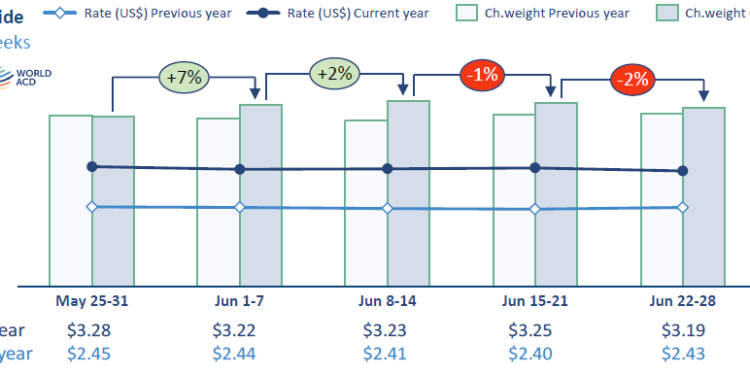


The global air cargo market entered a softer phase in the first full week of May, with tonnage, pricing, and available capacity all moving lower as seasonal demand drivers faded across key origin markets. Following several weeks of elevated activity linked to Asia’s holiday shipping cycle and Mother’s Day perishables demand, the market has now entered what appears to be a period of normalization—though underlying annual comparisons continue to paint a fundamentally resilient picture.
According to the latest weekly market analysis from WorldACD, based on more than 500,000 weekly airfreight transactions worldwide, global chargeable weight declined by 3 percent week-on-week during the period of May 4 to May 10, while average global pricing also eased by 3 percent to US$3.22 per kilogram. Available cargo capacity slipped by 2 percent globally, marking the first synchronized decline in all three indicators in several weeks.
Seasonal Demand Winds Down
Much of the week’s contraction was driven by the conclusion of two major seasonal traffic catalysts.
The first was the end of the Mother’s Day flower rush, which had significantly boosted exports from Central and South America in late April. As floral shipments normalized, outbound cargo volumes from the region dropped sharply by 19 percent week-on-week.
Related Post


The second factor was the conclusion of “Super Golden Week” across Asia—combining Japan’s Golden Week holidays with public holidays in China and South Korea—which temporarily suppressed manufacturing and export activity across several of the region’s largest cargo markets.
As a result, outbound chargeable weight from Asia-Pacific fell by 5 percent week-on-week, contributing to a combined two-week decline of 8 percent.
Global tonnage over weeks 18 and 19 was down 6 percent compared with the preceding fortnight, underscoring how quickly seasonal demand can unwind once holiday cycles conclude.
Asia-Pacific: Sharp Holiday Corrections
Asia-Pacific origins experienced some of the steepest volume corrections.
Exports from Japan fell dramatically, with chargeable weight to the United States dropping 44 percent and shipments to Europe falling 54 percent compared with the previous week.
Cargo volumes from Asia-Pacific to both Europe and North America were broadly weaker across most trade lanes. However, select Southeast Asian exporters continued to demonstrate resilience.
Vietnam emerged as a standout performer, recording a 22 percent week-on-week increase in cargo volumes to Europe—suggesting continued demand from manufacturing sectors such as electronics, apparel, and industrial components.
Meanwhile, outbound tonnage from China and Hong Kong to the United States remained robust on a year-on-year basis, posting growth of nearly 50 percent, reflecting sustained e-commerce and high-value manufacturing demand despite short-term volatility.
Middle East and South Asia: Diverging Signals
Cargo originating from the Middle East and South Asia (MESA) fell 4 percent overall during the week, though route-level dynamics were notably mixed.
Exports from the region to Europe weakened as cargo volumes out of Dubai and Bangladesh contracted sharply.
By contrast, shipments from Dubai to the United States surged by an extraordinary 65 percent week-on-week, recovering from weakness recorded the previous week.
India and Sri Lanka, however, recorded moderate declines on U.S.-bound lanes, illustrating the uneven recovery pattern across the region.
On an annual basis, MESA remains one of the strongest-performing cargo origin markets, with overall outbound tonnage up 6 percent year-on-year. Pricing from the region has been particularly strong, supported by earlier capacity disruptions and elevated fuel costs.
Pricing Retreats—but Remains Elevated
With demand easing, global pricing moved lower for the week.
Average worldwide airfreight rates declined by 3 percent to US$3.22 per kilogram, matching the decline in global chargeable weight.
The sharpest pricing corrections were seen in:
Central & South America: down 8%
Africa: down 7%
Both declines were largely attributable to the end of flower export demand.
Europe was the only major origin market to record a slight increase in average rates, rising 1 percent week-on-week, while North American pricing remained broadly unchanged.
Despite the weekly correction, pricing continues to run significantly above last year’s levels.
Global average rates are currently 39 percent higher year-on-year, while spot market pricing is up 51 percent—underscoring the structural impact of fuel costs, geopolitical uncertainty, and ongoing network adjustments.
Capacity Growth Begins to Stall
The decline in demand has now started to influence available lift.
Global cargo capacity fell 2 percent week-on-week, with the largest reductions recorded in:
Central & South America: down 4%
Asia-Pacific: down 3%
North America: down 2%
Africa: down 2%
Capacity from Europe and MESA remained broadly flat, indicating that the rebuilding of lift in Gulf markets may be reaching a plateau.
Industry observers note that freighter operations by Gulf-based carriers have largely recovered, but passenger bellyhold capacity remains below full restoration due to ongoing geopolitical caution and traveler uncertainty in the region.
Fuel Costs Begin to Influence Network Planning
Another emerging pressure point is fuel.
With jet fuel prices remaining elevated amid continuing geopolitical tensions in energy markets, airlines have begun trimming marginal routes and reducing frequencies on less profitable sectors.
Industry data suggests carriers have removed approximately 13,000 flights from May schedules globally, primarily impacting regional narrowbody operations. While the immediate effect on long-haul cargo capacity remains limited, some intercontinental services have also been affected.
Should fuel prices remain elevated through the summer, airlines may be forced into further network rationalization—potentially tightening available bellyhold space during the traditionally strong third-quarter shipping cycle.
Market Outlook
While week 19 reflects a clear post-holiday correction, the broader market remains fundamentally stronger than a year ago.
Global tonnage is still up 5 percent year-on-year, with most origin regions recording positive growth. Pricing continues to hold well above 2025 levels, and structural demand from e-commerce, pharmaceuticals, and time-sensitive manufacturing remains intact.
The coming weeks will now determine whether this slowdown represents a temporary seasonal pause—or the beginning of a broader mid-year recalibration for global airfreight.