
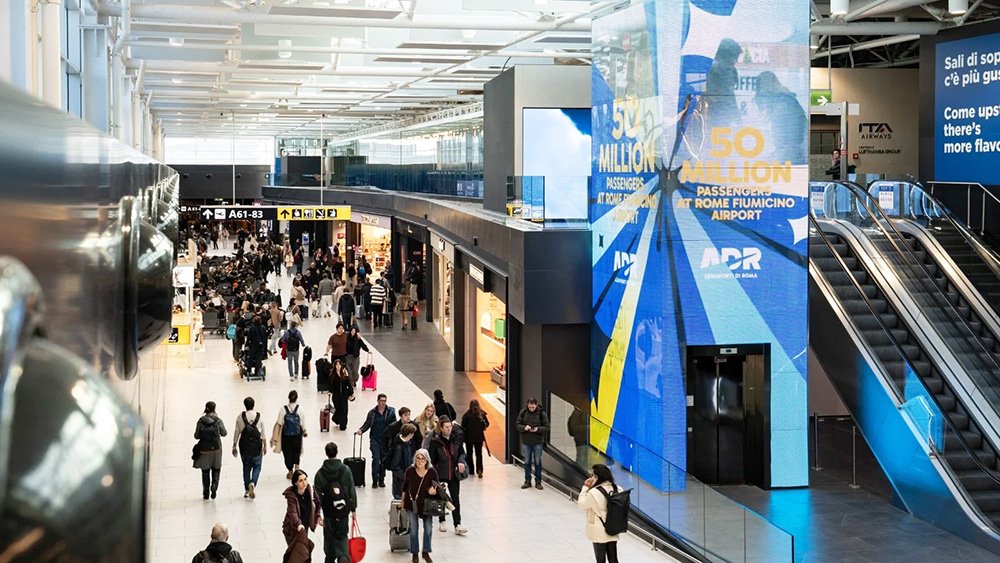
Aeroporti di Roma (ADR) has expanded its collaboration with Outsight to deploy large-scale artificial intelligence-powered passenger flow management systems at Rome Fiumicino Airport, marking a significant step in the airport’s transition toward data-driven, predictive operations.
The expanded deployment introduces Spatial Intelligence technology across nearly all common-use areas within the Schengen zone of the airport, significantly scaling up an initial pilot programme launched under ADR’s “Runway to the Future” innovation initiative. The early phase of the project, which focused on arrivals and immigration processing, demonstrated measurable operational improvements, prompting full-scale implementation.
AI and Lidar Technology at Core of Operations
The system is based on Outsight’s Physical AI platform, which uses 3D LiDAR sensors combined with advanced analytics to generate real-time insights into passenger movement patterns. The technology enables continuous monitoring of queue formation, congestion levels, and passenger flow dynamics across key airport zones.
Related Post


By converting spatial data into actionable intelligence, the platform provides ADR with a comprehensive, end-to-end view of passenger journeys. This allows airport operators to optimise resource allocation, improve terminal efficiency, and proactively manage bottlenecks in high-traffic areas.
The deployment forms part of a broader digital transformation strategy at Rome Fiumicino, which is consistently ranked among the world’s leading airports by Skytrax. The airport is operated by ADR, a company within the Mundys Group portfolio.
From Pilot Project to Industrial-Scale Deployment
The transition from pilot phase to full-scale implementation reflects growing confidence in the application of spatial intelligence technologies within complex airport environments. The system is now being integrated across Schengen common-use areas, significantly expanding its operational footprint.
According to ADR, the technology provides real-time visibility into passenger flows, enabling more agile decision-making and supporting data-driven redesign of operational processes. It also lays the groundwork for future integration with predictive and autonomous systems, including emerging Agentic AI applications in airport management.
Enhancing Operational Efficiency and Passenger Experience
Airport operators increasingly face pressure to manage rising passenger volumes while maintaining service quality and operational efficiency. The use of AI-powered monitoring systems is becoming a key enabler in addressing these challenges, particularly in large international hubs with complex terminal layouts and fluctuating traffic patterns.
The system deployed at Rome Fiumicino is designed to support dynamic resource allocation, reduce waiting times, and improve overall passenger experience through more responsive operational control.
Strategic Innovation Partnership
The collaboration between ADR and Outsight highlights a broader industry trend toward integrating advanced sensor technologies with artificial intelligence to modernise airport infrastructure.
Outsight’s platform combines LiDAR-based perception with real-time analytics to deliver high-resolution insights into physical environments, enabling airports to move from reactive operations to predictive management models.
The expansion of the system at Rome Fiumicino is expected to further refine its capabilities in a live operational environment, supporting continuous optimisation at one of Europe’s busiest aviation hubs.
Industry Outlook
As airports worldwide accelerate digital transformation initiatives, spatial intelligence and AI-driven operational systems are increasingly being adopted to improve efficiency, resilience, and passenger flow management.
Rome Fiumicino’s large-scale deployment positions it among early adopters of integrated physical AI systems in airport operations, setting a precedent for future smart airport developments across global aviation infrastructure.